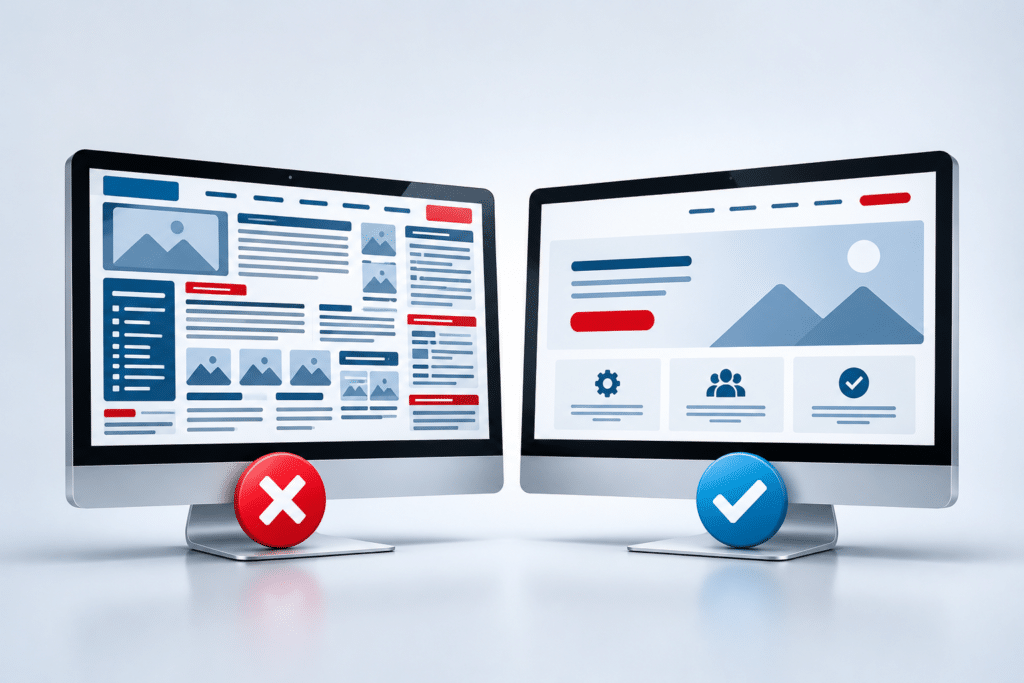

Why Every Service Your Business Offers Deserves Its Own Web Page
If your business offers several different services, take a quick look at your website. Does each important service have its own page, or have you squeezed everything onto one general Services page?
This is very common with small business websites. You might see a heading such as “Our Services”, followed by six boxes explaining six different services in a couple of sentences each. It looks tidy, but it may not give potential customers enough information to decide whether your business can actually help them.
Think about it from the customer’s point of view. If someone is interested in one particular service, they probably want to know much more than its name and a short description. They may want to know what is included, how it works, whether it is suitable for them, what problems it solves, how much it might cost and what they need to do next.
That is why every important service your business offers deserves serious consideration for its own web page.
Quick Answer
If a service is important enough for your business to sell, it will often benefit from having its own page on your website. A dedicated page gives you room to explain the service properly, answer common questions, build trust and give potential customers a clear reason to contact you. It can also help your business get found when people search online for that particular service.
Why One Services Page May Not Be Enough
There is nothing wrong with having a main Services page. In fact, most small business websites should probably have one because it gives visitors a quick overview of everything the business provides.
The problem comes when that is all you have.
Imagine you run a building company offering extensions, loft conversions, garage conversions, kitchen renovations and bathroom renovations. Your Services page might list all five, but somebody considering a loft conversion is unlikely to be satisfied with three sentences telling them that you do loft conversions.
They may want to understand what is involved, what types of loft can be converted, how the process works, what they need to consider and how they can arrange a quotation.
The same applies to almost every type of small business. An accountant may offer bookkeeping, payroll, tax returns and business accounts. A cleaning company may offer domestic cleaning, office cleaning, end-of-tenancy cleaning and carpet cleaning. A beauty business may provide facials, massage, waxing and other treatments.
These are different services purchased for different reasons. Giving them their own pages allows you to explain each one properly.
Think About How Your Customers Search
Your customers probably don’t sit at Google and search for a list of everything your business does. They usually search for the specific thing they need.
Someone with a leaking roof searches for roof repairs. Someone who needs help with their tax return searches for an accountant who provides tax return services. Someone moving out of a rented property may search for end-of-tenancy cleaning.
That person already knows what they want. If your website has a page specifically about that service, you can take them directly to information that matches what they are looking for.
Compare that with sending them to a homepage or general Services page where they have to work out whether you provide what they need. The less work you make visitors do, the better.
Give Customers Enough Information to Make a Decision
One of the biggest mistakes small businesses make with their websites is assuming customers already understand their services.
You understand them because you work with them every day. Your customers may not. They may have questions that seem obvious to you, such as what exactly is included, how long it takes, whether they need to prepare anything, whether you come to their home or whether you can help with their particular situation.
A dedicated page gives you room to answer these questions before the customer even picks up the phone.
This can also save you time. If you regularly answer the same basic questions by telephone or email, putting those answers on the relevant service page can help customers understand what you offer before they contact you.
It doesn’t mean you need to write an enormous essay about every service. You simply need to provide enough useful information to help somebody decide whether they want to take the next step.
Different Customers May Want Different Services
Your customers are not necessarily all looking for the same thing.
A cleaning company may have homeowners looking for regular domestic cleaning and businesses looking for weekly office cleaning. Both customers need cleaning, but their needs, questions and reasons for buying can be completely different.
Putting everything on one page makes it difficult to speak directly to each type of customer. Separate pages solve this problem.
Your office cleaning page can talk about keeping workplaces clean, working around business hours and providing regular cleaning schedules. Your domestic cleaning page can focus on helping homeowners keep their homes clean and freeing up their time.
You are still the same business. You are simply presenting each service in a way that makes sense to the person interested in buying it.
Each Service Page Gives You Another Chance to Be Found
There is another important benefit. Every useful service page gives your business another potential way to be discovered online.
Imagine an electrician offers rewiring, fuse board replacements, EV charger installation, landlord electrical certificates and emergency electrical repairs.
If all of those services appear on one page, the website has one general page trying to cover many different customer searches. Creating useful individual pages gives the business dedicated information about each service.
Someone searching for an EV charger installer could find the EV charger page. Someone needing an electrical certificate could find the certificate page. Another person searching for emergency electrical repairs could potentially discover the emergency repairs page.
This isn’t about stuffing pages with keywords or trying to trick Google. It is about creating useful pages that closely match the services people are genuinely looking for.
Service Pages Can Help With Local Searches
This becomes particularly useful for small businesses serving a particular town or area.
People often search for the service and the location together. They might look for a plumber in their town, a local accountant, an electrician nearby or a cleaning company serving their area.
Your service pages give you somewhere to explain not only what you do but also where you provide the service.
That does not mean filling the page with town names over and over again. It means making it clear where you work when location matters to the customer.
For example, a local roofing company could explain its roof repair service and naturally mention the main area it covers. This gives customers useful information while helping search engines understand the relevance of the page.
They Can Also Help AI Understand What Your Business Does
Customers are no longer finding businesses only through traditional Google searches. Some are using AI assistants and AI-powered search tools to research products, services and local businesses.
This makes clear website content increasingly important. If your website simply says “We offer a complete range of professional solutions”, it does not explain very much. Neither a customer nor a computer system should have to guess what those solutions actually are.
Compare that with a website containing clear pages explaining exactly what the business provides.
A plumber might have separate pages for boiler servicing, boiler repairs, bathroom installation and emergency plumbing. An accountant might have pages for bookkeeping, payroll and tax returns.
This gives search engines and AI systems clearer information about the business.
Having individual pages does not guarantee your business will appear in AI answers, but it does make your services easier to understand.
You Can Send People Straight to the Right Service
Separate pages are also useful outside Google.
Imagine someone asks on Facebook, “Does anyone know a company that does end-of-tenancy cleaning?” Instead of replying with your homepage and expecting them to search through your website, you can send them directly to your end-of-tenancy cleaning page.
The same applies to emails, WhatsApp messages, networking groups, online directories and social media. If somebody asks about a particular service, you have a page specifically designed to explain it.
This can make your business look more professional because you are not simply saying, “Yes, we do that.” You can show them a proper page explaining exactly what you provide.
Service Pages Can Make Your Advertising More Relevant
Individual pages can also be useful if you run online advertising.
Suppose you advertise three different services. Someone clicks an advert for bathroom installation but lands on a general homepage talking about everything from kitchens to extensions.
The visitor now has to find the bathroom information themselves. A better approach is often to send them directly to a page about bathroom installation.
The advert and the page then continue the same conversation. The person clicked because they were interested in bathrooms, and the page they reach is about bathrooms.
The same idea applies to links from social media posts, email campaigns and other marketing. Wherever possible, send people to the page most relevant to what interested them in the first place.
What Should You Put on a Service Page?
You don’t need to make this complicated. Start by thinking about what a potential customer would want to know before contacting you.
A useful service page could explain:
- What the service is.
- Who the service is for.
- What problems it solves.
- What is included.
- How your service works.
- What the customer can expect.
- Why they might choose your business.
- Areas you cover, where relevant.
- Common questions about the service.
- Prices or starting prices, if appropriate.
- How to request a quote, book or contact you.
You don’t necessarily need every item on every page. A straightforward service may only need a relatively simple explanation, while something expensive or complicated may require much more information.
The important thing is to answer the questions that matter to your customers.
Use the Questions Customers Already Ask You
You probably already have most of the information you need. Think about the questions customers ask you on the phone, by email, on WhatsApp or when you meet them.
If five customers have asked the same question, there is a good chance future customers will want to know the answer too. Those questions can help you decide what belongs on each service page.
You don’t need to guess what people want to know. Your existing customers have probably been telling you for years.
Don’t Create Pages Just for the Sake of It
There is a sensible limit to this strategy.
You shouldn’t create separate pages for every tiny variation of something you sell if there is nothing useful to say about them individually.
Suppose you offer two services that are almost identical and would require virtually the same explanation. One strong page covering both may be more useful than two pages repeating the same information.
The goal isn’t to make your website as large as possible. The goal is to give important services enough space to be understood.
If a service makes money for your business, customers actively look for it and you can provide useful information about it, that is a strong reason to consider giving it a dedicated page.
Expert Insight From Daren Ward
Daren Ward – Founder, A to Z Website Solutions
After more than 20 years of working with business websites, one issue I still regularly see is businesses offering far more than their websites make obvious.
A company may provide ten different services, yet eight of them are hidden inside a few sentences on one page. The business owner knows they provide those services, existing customers may know, but a new visitor arriving from Google, social media or somewhere else may not.
I think a simple question is worth asking: If someone visited your website specifically looking for one of your main services, would they find enough information to make them want to contact you?
If the answer is no, that service probably needs more attention.
Action Checklist
Take ten minutes and review your website:
- Write down all the main services your business currently sells.
- Check which services already have their own pages.
- Identify important services that only receive a sentence or short paragraph.
- Think about what customers normally ask about each service.
- Check whether your website answers those questions.
- Make sure your main Services page links to individual service pages.
- Check that each page clearly explains what is included.
- Make it obvious where you provide the service if location matters.
- Give visitors a clear way to contact you or request a quote.
- Remove outdated services you no longer provide.
- Review your website whenever you introduce a new service.
You may discover that your business has several valuable services that your website barely mentions.
Frequently Asked Questions
Does Every Service Really Need Its Own Page?
Not necessarily. Your important services usually deserve their own pages when there is enough useful information to explain them properly. Very small or closely related services can sometimes be grouped together if that makes more sense for customers.
Should I Keep My Main Services Page?
Yes. Your main Services page can act as an overview of everything your business offers. Give visitors a short introduction to each main service and then let them click through to a dedicated page if they want more information.
Will Separate Service Pages Help Me Get More Customers?
They can help because potential customers receive more relevant information about the exact service they want. A dedicated page can answer their questions, build confidence and make the next step clearer. Whether this results in more enquiries will also depend on your offer, reputation, website traffic and other factors.
Can Service Pages Help My Business Appear on Google?
Useful individual service pages can give search engines clearer information about what your business provides and create pages relevant to specific searches. However, simply creating a page does not guarantee rankings. The page still needs to be useful, trustworthy and relevant.
Do Service Pages Need Lots of Words?
No. There is no magic word count. A page should contain enough information to answer the important questions a potential customer has. Some services need more explanation than others.
What If I Don’t Know What to Write?
Start with the questions customers already ask you. Explain what the service is, who it helps, what is included, how it works and what somebody should do if they are interested. You probably already explain most of this when speaking to potential customers.
Should I Show Prices?
That depends on your business. If you have fixed prices or clear packages, showing them can be useful. If every job is different, you could explain how quotations work or what affects the price rather than publishing a fixed figure.
Can I Add New Service Pages to My Existing Website?
Usually, yes. You do not necessarily need a completely new website. You can often expand an existing website by adding pages for important services and linking to them from your Services page and other relevant parts of the site.
Should I Create Pages for Services I Rarely Sell?
Think about whether you actually want more customers for that service. If it is something you actively offer and want to grow, a dedicated page may make sense. If it is something you barely provide or intend to stop offering, giving it a prominent page may not be worthwhile.
What Happens When I Introduce a New Service?
Your website should change as your business changes. When you introduce an important new service, don’t just add its name to a list. Consider whether it deserves its own page so potential customers can understand what you are offering from the start.
Summary
Your website is often one of the first places a potential customer goes to find out whether your business can help them. If one of your important services is represented by just two sentences on a general Services page, you may not be giving that customer enough information to choose you.
Individual service pages give you space to explain what you do, answer questions, build confidence and make it easy for customers to take the next step. They can also give your business more opportunities to be found through search engines and make your services clearer to AI-powered search tools.
You don’t need a page for every tiny thing your business does. Focus on the services that matter to your customers and your business.
A simple place to start is to write down your five most important services and then look at your website. Does each one have the page it deserves?
Need Help With Your Business Website?
If your business offers several services but your website doesn’t explain them properly, it may be time to review how the site is structured.
A to Z Website Solutions helps small businesses create and improve websites that clearly explain what they offer and make it easier for potential customers to take the next step. We can also help with SEO and AI visibility so your website is built for the way people are finding businesses today.
Key Takeaways
- Your main Services page can provide an overview, but important services often deserve their own pages.
- Customers usually look for a specific service rather than everything your business provides.
- Dedicated pages let you answer the questions customers have before they contact you.
- Each service page can give your business another opportunity to be discovered online.
- Local businesses can clearly explain which services they provide and where they provide them.
- Individual pages are useful for advertising, social media, email and direct customer enquiries.
- Clear service information can also make your business easier for search engines and AI systems to understand.
- You do not need pages for every tiny service variation.
- Focus on creating genuinely useful pages for the services that matter most to your customers and your business.