
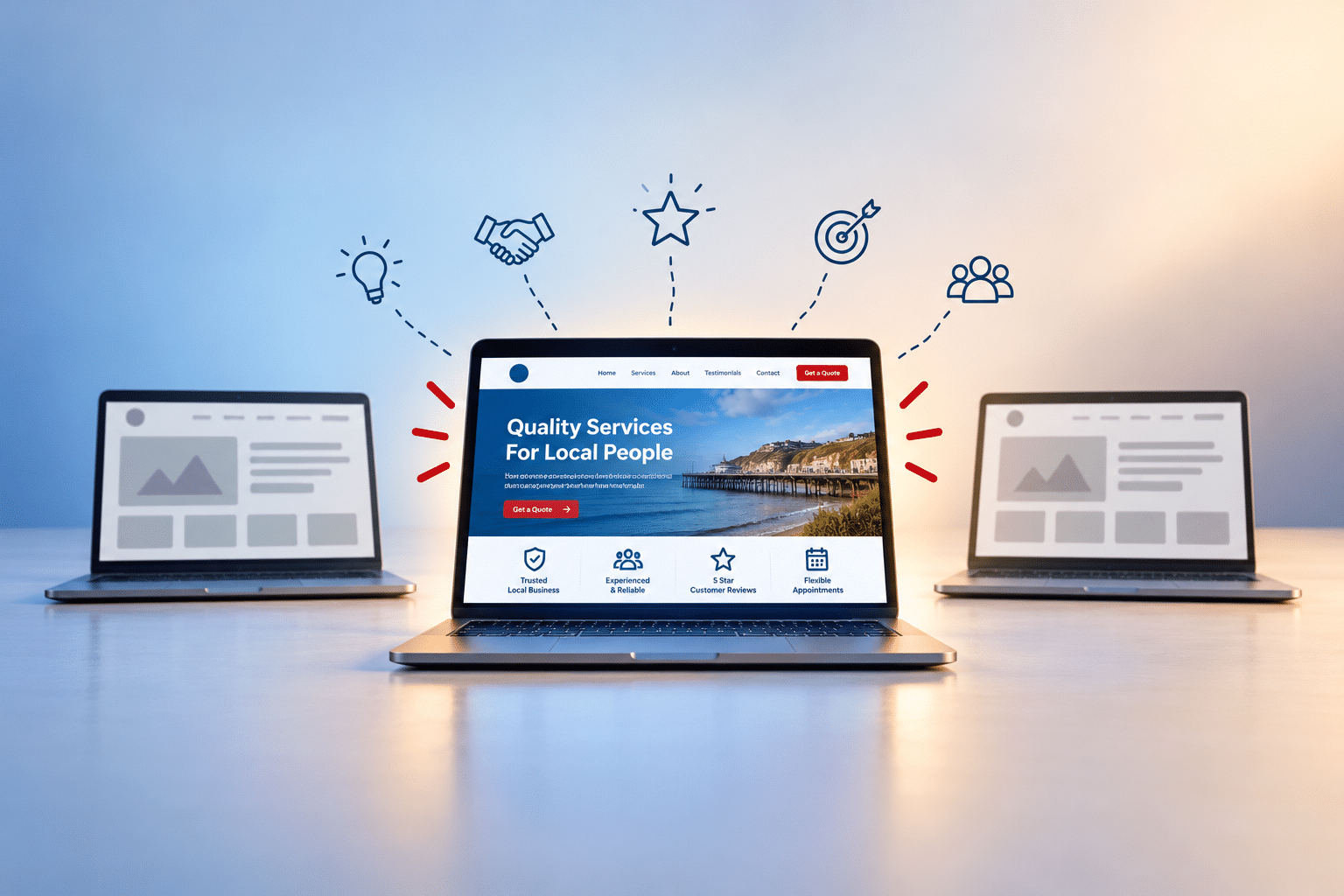
How Can I Make My Small Business Website Stand Out?
Take a look at a few websites belonging to businesses in your area. Whether you’re searching for a plumber, electrician, accountant or cleaning company, you may notice something familiar. Many websites look remarkably similar. They use the same type of photographs, make the same promises and say very little about why you should choose one business over another.
If you’re running a small business, that creates both a problem and an opportunity. Your website could be competing with dozens of others offering similar services. But you don’t need the biggest budget, the most complicated design or the flashiest animations to make a better impression.
What you need is a website that makes your business easy to understand, gives customers genuine reasons to trust you and helps them take the next step. Often, the things that make a website memorable are surprisingly simple.
Quick Answer
To make your small business website stand out, focus on what makes your business genuinely different and communicate it clearly. Use a strong opening message, real photographs, helpful service information, genuine customer reviews and an easy way for visitors to contact you.
Your website should answer three questions quickly: What does your business offer? Why should someone choose you? What should they do next?
You don’t need expensive visual effects or a complicated website to achieve this. A clean, mobile-friendly design supported by clear wording, useful information and genuine evidence of your work can make a stronger impression than a more elaborate website that leaves customers confused.
What Makes a Small Business Website Stand Out From Competitors?
A website stands out when customers can quickly see something useful, relevant or reassuring that they don’t immediately find elsewhere. That difference might be your specialist experience, the way you work, your customer service, the areas you cover or the information you provide.
For example, imagine two local cleaning companies. Both websites promise professional cleaning, competitive prices and excellent customer service. Neither gives much detail about the actual service.
Now imagine one website explains exactly what’s included in a standard clean, how customers can get a quote, whether cleaning materials are supplied and how appointments are arranged. It also includes genuine photographs and reviews.
That website has given potential customers several practical reasons to consider the business. It hasn’t needed an unusual design to do so.
The aim isn’t simply to look different. It’s to make choosing your business easier.
1. Make Your Main Website Message Clear
Your homepage should explain what your business does without making visitors search for the answer. People shouldn’t need to read several paragraphs or explore your menu to work out whether you offer the service they need.
Start with a clear heading that describes your main service and, where relevant, the area you cover. Then add a short explanation of what customers can expect.
Compare these two homepage messages
Generic: “Welcome to our website. We provide quality solutions and exceptional customer service.”
More useful: “Domestic and Commercial Cleaning in Dartford. Regular cleaning, deep cleans and end-of-tenancy services with straightforward quotes.”
The second example immediately tells visitors what the business offers and where it operates. Customers can decide whether it’s relevant without having to guess.
You can still have a friendly, welcoming message. Just make sure it doesn’t hide the important information.
2. Explain What Makes Your Business Genuinely Different
Many businesses describe themselves as reliable, friendly, professional and affordable. Those qualities matter, but they don’t tell customers much when every competitor makes similar claims.
Instead, think about what your business actually does differently. Perhaps you offer weekend appointments, specialise in older properties, provide written quotes or have particular experience with a type of customer.
These are details that can help customers decide whether you’re right for them.
Ask yourself these questions
- What do customers regularly thank us for?
- What questions do people ask before choosing us?
- Do we specialise in something other businesses don’t emphasise?
- Is there anything about our service that makes life easier for customers?
- What can we genuinely promise and deliver?
You don’t need to invent a dramatic selling point. Sometimes your strongest difference is simply explaining your service more clearly than your competitors do.
For example, an accountant who explains how monthly fees work and what support is included may be more appealing to a small business owner than one whose website only promises expert accounting solutions.
3. Use Genuine Photographs Instead of Generic Stock Images
Real photographs can help make your website more personal and believable. Customers often want to see the people, products or work behind a business, particularly when they’re inviting someone into their home or trusting them with an important job.
A local electrician might show photographs of completed installations. A hairdresser could display examples of actual hairstyles, with customer permission. A garage could show its equipment or completed work.
These images tell visitors something specific about the business that a generic stock photograph cannot.
What if you don’t have professional photographs?
You don’t necessarily need an expensive photography session. Clear, well-lit photographs taken with a modern smartphone may be suitable for many small business websites.
Make sure images are sharp, relevant and show your work accurately. Avoid cluttered backgrounds and don’t publish photographs of customers, their homes or private information without suitable permission.
Stock photography can still be useful where genuine images aren’t available. The important thing is not to present stock models or invented scenes as your actual team or completed work.
4. Give Customers Real Reasons to Trust Your Business
Before contacting a business they’ve never used, customers often look for reassurance. They want to know whether the business is genuine, whether it understands their needs and whether other people have been happy with its service.
Your website should make relevant trust information easy to find.
Useful trust signals include:
- Genuine customer reviews and testimonials.
- Clear business contact details.
- Accurate information about your experience.
- Relevant qualifications or professional memberships.
- Photographs of completed work.
- Clear explanations of how your service works.
- Details of guarantees or insurance where genuinely applicable.
For example, a roofing company might show completed roofing projects alongside short explanations of the work involved. A beauty salon might display real treatment photographs and verified customer feedback.
Don’t overload every page with badges and claims. Choose the evidence most relevant to the customer’s decision and make sure it’s accurate.
If keeping track of customer feedback is becoming difficult, online reputation management can help businesses take a more organised approach to reviews and credibility.
5. Answer the Questions Your Customers Are Already Asking
One of the easiest ways to improve your website is to think about the questions customers ask before buying. These questions often reveal exactly what information your website is missing.
If you run a carpet cleaning business, customers might ask how long carpets take to dry, whether furniture needs moving and how quotes are calculated.
If you’re an accountant, customers may want to know which types of businesses you support, whether meetings can be held online and what information is needed before an appointment.
Turn everyday customer questions into useful website content
Write down the ten questions you hear most often. Check whether your website answers them clearly. If not, add the missing information to the relevant service page or a helpful FAQ section.
This approach can make your website more useful while saving you time answering the same basic questions repeatedly.
It may also help your pages match the questions people search for online, although adding FAQs alone doesn’t guarantee higher search rankings or appearances in AI-generated answers.
6. Make Your Website Easy to Use on a Mobile Phone
A website that looks impressive on a large computer screen can still frustrate customers using a phone. Tiny text, difficult menus, oversized images and awkward forms make it harder for visitors to find what they need.
Your mobile website should be treated as a main part of the customer experience, not an afterthought.
Check these mobile essentials
- Text is readable without zooming.
- Buttons are large enough to tap comfortably.
- Menus are simple and easy to open.
- Important information appears near the top.
- Photographs fit the screen properly.
- Contact forms are straightforward to complete.
- Pages load promptly and don’t jump around while loading.
Try using your website on your own phone without relying on what you already know about the business. Can you find a service, check the areas covered and make an enquiry without difficulty?
If not, those are sensible areas to improve before spending money on more elaborate design features.
7. Make It Ridiculously Easy for Customers to Contact You
A surprising amount of effort can go into attracting visitors to a website, only for the contact process to make things unnecessarily difficult.
Imagine someone wants an urgent plumbing repair. They find your website, read about your services and decide to contact you. But the phone number is hidden at the bottom of a long page, and the contact form asks for information they don’t have.
That creates an avoidable obstacle at the exact moment the visitor is ready to enquire.
Choose contact options that suit your customers
A mobile service business might benefit from a prominent telephone number and short quote form. A beauty salon may need an appointment booking link. An accountant might prefer a consultation enquiry form.
Whatever method you choose, make it obvious and reliable. Test your forms regularly, check that enquiries reach the correct email address and explain when customers can expect a response.
Not every business needs live chat, online booking and several contact methods. One or two well-managed options may work better than a collection of features nobody monitors.
8. Create a Recognisable Look Without Overcomplicating the Design
A consistent visual style helps customers recognise your business and makes your website feel more organised. This doesn’t require unusual fonts, dramatic effects or a different layout on every page.
Start with a small set of suitable brand colours, readable fonts and consistent spacing. Use the same approach for headings, buttons and service information throughout the website.
For example, a local bakery might use warm colours and clear product photography. An accounting practice might prefer a quieter design that puts information and readability first.
Neither approach is automatically better. The design should fit the business and make the content easier to understand.
Don’t mistake unusual for effective
Animations, moving backgrounds and unexpected layouts can attract attention, but they can also distract visitors. If an effect makes the website slower or harder to use, it may be working against you.
A professional appearance comes from consistency, clarity and attention to detail, not the number of visual tricks on the page.
9. Show That You Understand Your Local Customers
If your business serves a particular town or area, make that clear on your website. Local customers often want to know whether you cover their location, understand their needs and can provide the service they require.
A mobile mechanic could explain the towns covered and the types of roadside or home appointments available. A cleaning company could describe its regular service areas and how customers can arrange a visit.
Use genuine local details
Include accurate service-area information, relevant examples of work and clear contact details. If you have a physical business location that customers can visit, provide useful directions and opening information.
Avoid creating dozens of nearly identical pages for nearby towns simply to repeat place names. Each page should offer genuinely useful information rather than changing a few words.
Local relevance should come from what your business actually offers, not from stuffing locations into every heading.
10. Publish Content That Helps Customers Make Decisions
Helpful articles, guides and service explanations can give people another reason to visit your website. They also give your business an opportunity to demonstrate its knowledge without relying on exaggerated claims.
For example, an electrician might explain what customers should check before arranging an electrical inspection. A garage could publish a simple guide to preparing a car for its MOT. A cleaning company might explain how customers can prepare for an end-of-tenancy clean.
Good content answers real questions and helps customers understand their options.
Quality matters more than publishing constantly
You don’t need to publish an article every day. A small collection of useful, accurate guides can be more valuable to readers than dozens of repetitive posts.
Update information when services, prices, rules or other important details change. Avoid publishing articles that sound impressive but don’t actually answer the reader’s question.
When planning content, begin with the questions your customers ask most often. Those are usually more useful starting points than writing about a topic simply because it contains a popular keyword.
11. Consider a Short Video That Explains Your Business
Some services are easier to understand when customers can see them in action. A short, well-made video can explain what you offer, show your work or introduce the people behind your business.
For example, a personal trainer might demonstrate the type of sessions available. A garage could show what happens during a routine service. A beauty salon might explain a treatment and what customers can expect.
The video doesn’t need to be expensive or highly produced. Clear sound, useful information and an appropriate length are often more important than complicated editing.
Keep the video helpful
Make sure the video has a clear purpose. Don’t make visitors watch it before they can access important information. Provide captions where appropriate and avoid setting sound to play automatically.
A video should support the written content, not replace the basic information customers need.
12. Make the Entire Website Experience Better Than Customers Expect
Standing out isn’t only about what people see when they first arrive. It’s also about how smoothly the website works from beginning to end.
Can visitors understand your services? Can they compare their options? Are important details easy to find? Does the website work properly when they try to contact you?
Small improvements to these everyday tasks can make a meaningful difference to how professional your business feels.
Test the customer journey
Ask someone who doesn’t know your website well to complete a simple task. For example, ask them to find the price of a service, check whether you cover a particular area or submit a test enquiry.
Watch where they hesitate or become confused. Don’t immediately explain where they should click. Their difficulties may reveal problems that you’ve stopped noticing because you’re familiar with the website.
This is a practical way to identify improvements without relying on expensive software or complicated testing.
What Matters More Than an Impressive Website Design?
An attractive design can help create a positive first impression, but customers also need useful information and a straightforward way to take action.
Consider these differences between a website that focuses mainly on appearance and one designed around customer needs.
| Appearance-first approach | Customer-first approach |
|---|---|
| Large animated introduction | Clear explanation of the main service |
| Generic claims about quality | Specific reasons to choose the business |
| Stock photographs everywhere | Relevant genuine business photographs |
| Long, complicated contact form | Simple enquiry process |
| Many pages with repeated wording | Useful pages answering customer questions |
| Design focused on desktop screens | Comfortable experience on mobile and desktop |
This doesn’t mean your website should look plain or unattractive. Good design and useful content work best together.
The strongest website is usually one where the visual style supports the message rather than competing with it.
Common Mistakes That Make Small Business Websites Blend In
Even well-established businesses can end up with websites that feel generic or difficult to use. Often, this happens because the site has been built around what the owner wants to say rather than what customers need to know.
Copying a competitor’s website
It’s sensible to look at other websites for ideas, but copying their wording, layout or claims won’t help you explain what makes your business different. Use competitor research to identify gaps and opportunities, not to create another version of the same website.
Talking only about your business
Customers want to understand your experience, but they also want to know how your service helps them. Balance information about your business with practical explanations of what customers can expect.
Making promises without evidence
Claims such as “the best in town” or “number one service” can sound empty without reliable evidence. Clear details, genuine reviews and examples of work are usually more helpful.
Adding too many features
Pop-ups, moving banners, chat windows and repeated buttons can make a website feel busy. Use features because they help customers, not because they happen to be available.
Neglecting the website after launch
An outdated website can create uncertainty. Check contact information, service details, photographs and forms regularly. Remove expired offers and correct information that is no longer accurate.
Important: Don’t Invent Trust Signals
Never add made-up reviews, qualifications, awards, customer photographs or business guarantees simply to make your website look more impressive.
Use only claims you can support and images you have permission to publish. Misleading information can damage customer trust and may create legal problems. A smaller amount of genuine evidence is better than an impressive-looking collection of claims that aren’t true.
Expert Insight From Daren Ward

Having worked in website design and online marketing since 2004, I would encourage small business owners to look beyond the visual appearance of their websites.
In my experience, it’s easy to spend too much time choosing colours, photographs and layouts while giving less attention to the information customers actually need.
One practical exercise I recommend is opening your website alongside two or three competitors’ websites. Imagine you’re a customer who knows nothing about any of the businesses.
Ask yourself which website makes it easiest to understand the service, which gives you the most confidence and which makes contacting the business simplest.
Then look at your own website and ask a more difficult question: “Have I given customers a genuine reason to choose my business, or have I simply told them that we’re professional, reliable and friendly?”
I believe the businesses that communicate clearly, answer questions and make life easier for customers often have a better foundation than those concentrating mainly on making their websites look impressive.
My recommendation would be to improve the clarity of your message and the customer experience before spending heavily on visual effects. Those improvements are often practical, affordable and worth making regardless of your website’s age.
Action Checklist: Make Your Small Business Website Stand Out
- Open your homepage and check whether your main service is immediately clear.
- Write down three genuine reasons customers choose your business.
- Replace vague marketing claims with specific, accurate information.
- Add suitable genuine photographs of your work, products or team.
- Make relevant customer reviews and trust information easy to find.
- List the ten questions customers ask most often and check your website answers them.
- Test the website on a real mobile phone.
- Check that telephone numbers, contact forms and booking links work.
- Make your service areas and availability clear where relevant.
- Use consistent colours, headings and buttons throughout the website.
- Ask someone unfamiliar with your website to find a service and make a test enquiry.
- Review two or three competitor websites and identify information yours could explain better.
Frequently Asked Questions
1. How can I make my small business website stand out without spending a lot of money?
Start by improving the information customers see first. Make your main service clear, explain what makes your business different, add genuine photographs and simplify the contact process. These improvements may require more thought than money, particularly if you can update your existing website yourself.
2. Does my website need a completely unique design?
No. A professional website can use a familiar layout and still feel distinctive through its branding, photographs, content and customer experience. Visitors generally benefit from navigation and contact options that are easy to recognise rather than unusual layouts that make information harder to find.
3. Should I use bright colours to make my website stand out?
Bright colours aren’t automatically better. Choose colours that suit your business and make the website easy to read. Strong contrast, consistent branding and clear buttons are more useful than adding several bold colours simply to attract attention.
4. How important are customer reviews on a business website?
Genuine customer reviews can help visitors understand other people’s experiences with your business. Choose relevant feedback, make sure you have permission to use it where necessary and don’t change its meaning. Reviews should support your business information rather than replace clear service descriptions.
5. Can a small website compete with a larger competitor?
Yes, a smaller website can still provide an excellent customer experience. A local business may be able to explain its services, answer specific questions and communicate its local knowledge very clearly. However, a good website alone doesn’t guarantee that it will outrank or win customers from larger competitors.
6. Will a more attractive website improve my Google rankings?
Not automatically. Search visibility depends on several factors, including useful content, technical accessibility, relevance and competition. A clearer, faster and easier-to-use website may support your wider online presence, but appearance alone isn’t a direct guarantee of better rankings.
7. Should I put prices on my business website?
Where practical, clear pricing can help customers decide whether your service suits their budget. If every job requires an individual quote, explain how pricing works and what affects the cost. You don’t necessarily need fixed prices, but customers should understand what happens when they enquire.
8. Do I need a video on my homepage?
No. Video is optional and should serve a clear purpose. It can be useful for demonstrating a service, showing a process or introducing your business, but a clear written explanation and suitable photographs may be enough. Avoid adding video purely because competitors have one.
9. How many customer testimonials should I display?
There is no ideal number. A few relevant, genuine testimonials can be more useful than a large collection of repetitive praise. Choose feedback that helps customers understand your service, reliability or approach, and keep it accurate and appropriately attributed.
10. How often should I update my small business website?
Check important business information whenever something changes, including services, prices, opening hours and contact details. It is also sensible to review your website periodically for broken links, outdated content and technical problems. You don’t need to redesign the whole website every time you make an update.
11. Can better website wording help me attract more enquiries?
Clearer wording can help visitors understand your services and feel more confident about contacting you. Explain what you offer, who it is suitable for and how the enquiry process works. Whether enquiries increase will also depend on visitor numbers, customer demand and other factors.
12. Should I redesign my website or improve the one I already have?
That depends on the problems you’re trying to solve. If the website works well but has unclear wording or outdated photographs, targeted improvements may be enough. If it is difficult to use on mobile, technically unreliable or built on an unsuitable system, a redesign may be more practical.
Summary: Standing Out Is About Being More Useful, Not Just Looking Different
Making your small business website stand out doesn’t require an enormous budget or an unusual design. It starts with understanding what your customers need and making that information easier to find than it is on competing websites.
Clear service descriptions, genuine photographs, helpful answers, trust signals and simple contact options all contribute to a better experience. Consistent design and mobile usability help bring everything together.
Rather than trying to impress visitors with complicated effects, focus on helping them understand your business and feel confident about taking the next step. That’s a more useful goal than simply having the most eye-catching website in your industry.
Your Next Step
If your existing website looks dated, feels too similar to your competitors or doesn’t explain your business clearly enough, our website redesign service is one option for improving its appearance, usability and overall customer experience.
Key Takeaways
- Make it immediately clear what your business offers and who it helps.
- Explain genuine differences rather than relying on generic promises.
- Use real photographs and accurate customer feedback to build trust.
- Answer common customer questions before visitors need to contact you.
- Make your website easy to use on mobile phones.
- Keep contact options simple, visible and reliable.
- Use consistent branding rather than unnecessary visual effects.
- Focus on helping customers make decisions, not simply impressing them.
Found This Helpful? Share It
If you found this article useful, please share it with other business owners who might find it helpful too.
A quick share on LinkedIn, Facebook or your favourite social platform could help someone else find the advice they need.



