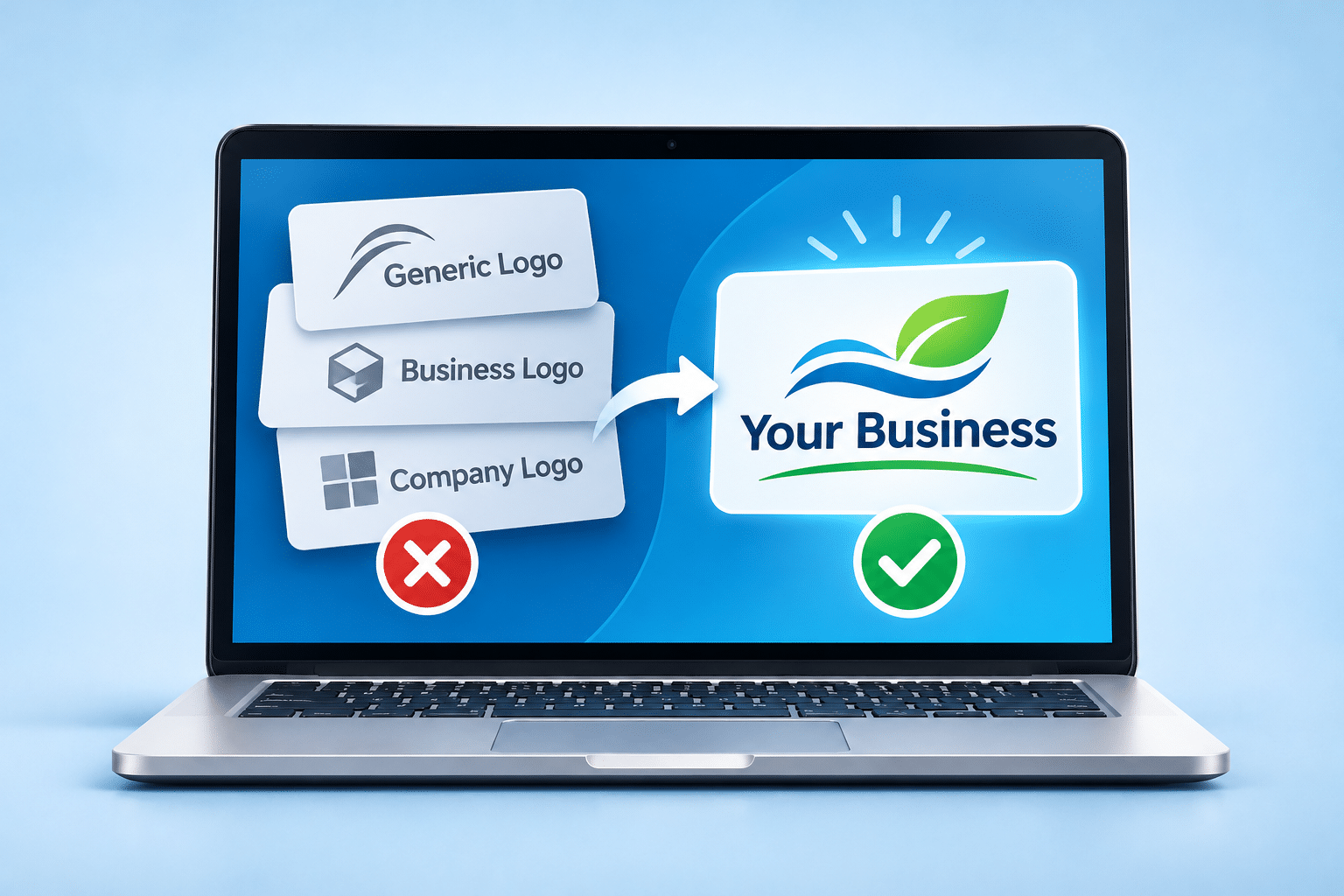
Does Every Business Need a Unique Logo?
Think about the businesses you regularly use. You probably recognise some of them from their logo before you’ve even read the company name. Others might have a simple name written in a particular colour or font. Both approaches can work, which raises an interesting question: does every business need a unique logo?
Imagine you’ve just started a plumbing business. You’ve bought your tools, arranged insurance, created a website and started looking for customers. Someone suggests spending hundreds of pounds on a professional logo, while another person tells you to make something yourself using a free online tool. You’re left wondering whether a logo is really that important when your main priority is getting work.
The answer depends on what stage your business is at, how you want customers to remember you and where your branding will appear. A logo won’t make a poor service successful, but a clear, distinctive design can help customers recognise your business and make your marketing look more consistent.
Quick Answer
No, every business does not legally need a logo, and a new business can operate without one. However, having a unique logo is generally a sensible investment because it gives your business a recognisable visual identity and helps customers distinguish it from competitors.
A good logo doesn’t need to be complicated or expensive. It should be easy to recognise, readable at different sizes, suitable for your type of business and different enough from existing designs to avoid unnecessary confusion. If you’re starting with a limited budget, a simple, well-chosen wordmark using your business name may be enough until you’re ready to invest in a more developed design.
What Is a Business Logo?
A business logo is a visual design used to identify a company, product or service. It might contain the business name, a symbol, distinctive lettering or a combination of these elements. Its main job is to help people recognise who they’re dealing with.
For example, a local bakery might use its business name in a distinctive typeface with a small illustration of a loaf of bread. A cleaning company could use a simple symbol with its name, while an accountant might prefer a professional wordmark without any illustration. Each approach can communicate a different impression.
A logo is only one part of your business identity. Your brand also includes the way you communicate, the quality of your work, your reputation and the experience customers have when dealing with you. A professional logo can support those things, but it cannot replace them.
Does Every Business Need a Unique Logo?
Every business can benefit from being recognisable, but that doesn’t mean every business needs an elaborate custom-designed symbol. A sole trader who gets most work through recommendations may be perfectly comfortable starting with a clear business name and consistent colours.
However, as your business grows, a distinctive logo becomes more useful. You may need it for your website, social media accounts, business cards, quotations, invoices, uniforms, vehicle graphics or packaging. Using the same design across these places can help customers connect your marketing with the business they already know.
The important distinction is between needing a logo to operate and benefiting from one as part of your marketing. In most ordinary circumstances, you don’t need a logo simply to start trading. But if you want to develop a recognisable business identity, having a consistent, distinctive design is usually a sensible step.
Why Having a Distinctive Logo Can Help Your Business
Make your business easier to recognise
When customers repeatedly see the same logo on your website, quotations and social media posts, they have a consistent visual cue to associate with your business. This can make recognition easier over time, particularly when the design is simple and memorable.
Help distinguish your business from competitors
Imagine three local electricians using nearly identical lightning bolt symbols, blue lettering and similar layouts. Customers could easily struggle to remember which business they contacted. A more distinctive design gives your business a better chance of standing apart visually.
Make your marketing look consistent
A logo provides a useful starting point for the colours, fonts and general appearance of your marketing materials. Your website, social media graphics, leaflets and business cards can follow the same visual style rather than looking as though they belong to different businesses.
Support a professional first impression
Customers often make an initial judgement about a business from what they see. A clean, readable logo can contribute to a professional appearance, especially when it sits alongside a well-presented website and clear business information. However, an attractive logo doesn’t prove that a business is reliable or provides good service.
What Makes a Logo Unique?
A unique logo is one that has its own recognisable visual character rather than simply copying an existing design. It doesn’t necessarily need an unusual symbol or complicated illustration. Sometimes the most distinctive logos use straightforward lettering, carefully chosen proportions and a consistent colour scheme.
For example, a garage could use a distinctive arrangement of its business name rather than another generic drawing of a car. A beauty salon might use elegant lettering with a subtle graphic element rather than the same familiar silhouette used by many similar businesses.
Uniqueness also needs to be considered in context. A design may look different when placed beside one competitor’s logo but appear very similar to another business operating in the same market. This is why checking existing designs before committing to a logo is worthwhile.
Different Types of Business Logos
There are several common approaches to logo design, and each can suit different types of businesses. You don’t need to know the technical terminology to choose one, but understanding the options can help you explain what you want.
| Logo Type | What It Looks Like | When It May Work Well |
|---|---|---|
| Wordmark | The business name in distinctive lettering. | Businesses wanting customers to remember their name. |
| Lettermark | Initials or an abbreviation. | Businesses with long names or established initials. |
| Symbol | A recognisable icon or graphic. | Businesses with an established identity or memorable symbol. |
| Combination logo | Business name and symbol together. | Many small businesses wanting flexibility. |
| Emblem | Text arranged within a badge or decorative shape. | Businesses seeking a traditional or badge-style appearance. |
A combination logo is often a practical option for a small business because customers can see both the company name and the symbol. If the design has been planned properly, you may also be able to use the symbol on its own in places where there isn’t enough room for the full logo.
What Kind of Logo Is Best for a Small Business?
The best logo depends on your business name, the services you offer and where the design will appear. A plumber who wants branding on a van may need bold, readable lettering that can be recognised from a distance. A jewellery business might prefer a more delicate design suited to packaging and product labels.
Start by considering how customers will encounter your logo. Will they mainly see it on a mobile phone, a shop receipt, a work uniform or a vehicle? A design that looks attractive on a large computer screen may become unreadable when reduced to a small social media profile image.
For many small businesses, I would favour clarity over decoration. A straightforward logo with readable lettering, sensible colours and a distinctive detail is often more practical than a complicated illustration that loses its meaning at smaller sizes.
How to Create a Logo for Your Business
Step 1: Decide what your logo needs to communicate
Think about the impression you want customers to have. A children’s party business might want something cheerful and approachable, while an accountant may prefer a calm, professional appearance. Your logo should suit your business rather than simply follow whichever design trend happens to be popular.
Step 2: Research other businesses in your industry
Look at the logos used by competitors and related businesses. Notice which colours, symbols and styles appear repeatedly. This research isn’t about copying their designs. It’s about understanding what customers are familiar with and identifying opportunities to create something different.
Step 3: Choose a simple design direction
Decide whether you want a wordmark, symbol or combination design. Consider a small selection of colours and fonts that reflect the character of your business. Avoid adding unnecessary details simply to make the logo appear more impressive.
Step 4: Test the logo in realistic situations
View the design on a mobile phone, a website header, a business card and any other places where you expect to use it. Check whether the name remains readable and whether the design still works in black and white. If the logo becomes unclear at smaller sizes, simplify it.
Step 5: Check originality and usage rights
Before approving the final design, check for similar branding in your industry and investigate any relevant trade marks. If you’re using design software, stock graphics or AI tools, review the licence terms and whether you have the rights needed for commercial use.
Step 6: Keep suitable logo files
Ask for versions suitable for websites, social media and printing. Ideally, you should have a vector version that can be enlarged without losing sharpness, together with transparent-background image files and any alternative colour versions you need. Keep the original files somewhere secure so you aren’t forced to recreate the logo later.
How Much Should You Spend on a Logo?
There isn’t one correct amount to spend on a business logo. You can create a basic design yourself using suitable software, pay for a template-based service or commission a professional designer to develop something specifically for your business.
The right choice depends on your budget and what you need. If you’re testing a new business idea, a simple wordmark may be enough initially. If you’re investing in vehicle graphics, packaging, signage and a complete website, it may be sensible to develop a more carefully planned identity before paying to produce those materials.
When comparing logo design services, ask what is included in the price. Check how many design concepts and revisions are provided, whether you receive vector files, what commercial usage rights are included and whether the designer will supply versions for different backgrounds.
Don’t assume that the most expensive logo will automatically be the best. Equally, a very cheap design can become costly if you later discover that it cannot be printed properly, is too similar to another logo or doesn’t include the files you need.
Can Another Business Use a Similar Logo?
Two businesses can sometimes use similar visual elements without automatically breaking the law. However, a logo that is too close to another business’s protected branding may create legal problems, particularly where customers could be confused about the source of goods or services.
In the UK, trade marks can protect distinctive signs used to identify goods or services, including certain logos. Copyright may also protect original artwork. These are different legal rights, and having a logo designed does not automatically mean you own every right connected to it.
You can search the UK trade mark register to investigate existing registered marks. You should also look at competitors’ websites and branding, including businesses that may have relevant rights without a registered trade mark.
Registering a trade mark is not compulsory for every business, and registration is not a guarantee against every possible dispute. If you plan to invest heavily in a brand or are concerned about a similar existing design, advice from a qualified trade mark professional may be worthwhile.
Warning: Check Logo Ownership Before Paying for Printing
Before spending money on vehicle graphics, uniforms, signage or large quantities of packaging, make sure you have the rights to use your logo and that it doesn’t create an obvious conflict with another business’s branding.
Ask your designer to confirm what rights are being transferred or licensed to you, and keep the agreement in writing. If a logo uses third-party graphics or fonts, check their commercial licence terms. Discovering a problem after you’ve paid for printed materials can be an expensive mistake.
Should You Use AI or a Logo Generator?
AI image generators and online logo-making tools can help you explore design ideas quickly. They may be useful when you’re starting a business, experimenting with colours or trying to understand which style you prefer. However, convenience doesn’t automatically mean the finished design will be suitable for long-term business use.
Some generated designs can look similar to common symbols or existing branding. Others may contain small details that become unclear when reduced in size. You should also check whether the service provides appropriate commercial rights and whether the finished design can be supplied in a usable vector format.
There can be additional questions about copyright protection for AI-generated material, depending on how it was created and the applicable law. A tool’s permission to use an image commercially is not the same as a guarantee that the design is original, legally protected or free from third-party claims.
If you use AI to explore ideas, treat the results as a starting point. Refine the design, check its suitability and consider professional help when you need something distinctive and ready for wider commercial use.
Common Logo Design Mistakes
One mistake is trying to include too much information. A cleaning company might want its logo to show a house, office, vacuum cleaner, bucket and every service it offers. Unfortunately, the result can become crowded and difficult to recognise. Your logo doesn’t need to explain your entire business.
Another mistake is choosing a design purely because it’s fashionable. A trendy font or visual effect may look appealing today but feel dated after a few years. A simple, well-balanced design is often easier to maintain as your business grows.
Businesses also sometimes forget to test their logo at different sizes. Thin lettering, tiny details and complicated colour effects can disappear when the design appears on a mobile phone or invoice. Checking small versions before approving the design can prevent this problem.
Finally, avoid repeatedly changing your logo without a good reason. If customers are becoming familiar with your branding, frequent changes can make recognition harder. A logo should have enough flexibility to serve your business for years rather than needing replacing whenever your tastes change.
When Should You Redesign Your Logo?
A logo redesign may be worth considering when your existing design no longer reflects your business, is difficult to read or cannot be used properly across different marketing materials. For example, a garage that has expanded into specialist vehicle services might want a more flexible identity than the one it created when it first opened.
However, a redesign isn’t always necessary. If customers already recognise your logo and the main problem is that the files are poor quality, you may only need the original design recreated as a clean vector version. This can preserve your existing identity while making it more suitable for printing and digital use.
Before changing anything, ask whether the current design is genuinely causing a problem. Sometimes improving the surrounding website, signage or marketing materials will have more value than replacing a logo that already works.
Expert Insight From Daren Ward

Having worked with business websites and visual design since 2004, one thing I would encourage business owners to think about is how their logo will work in everyday situations, not just how attractive it looks when presented as a large image.
A logo might look excellent on a designer’s screen, but what happens when you put it in the small header of your website or on a mobile phone? Can customers still read your business name? Does the design look clear on a white background and a dark background? These practical checks can reveal weaknesses before you spend money using the design across your business.
I would also recommend asking for a simple one-colour version of your logo before approving it. If the design only works because of gradients, shadows and complicated effects, it may be difficult to reproduce consistently. A logo that works in one colour gives you more flexibility for uniforms, printed materials and other uses.
My view is that a business should aim for a logo that is recognisable, practical and suitable for its customers. It doesn’t need to win a design competition. It needs to represent your business clearly and continue working as your business develops.
Action Checklist
- Decide whether your business needs a new logo or whether the existing design can be improved.
- Write down the impression you want customers to have of your business.
- Review logos used by competitors to identify common designs and possible similarities.
- Choose whether a wordmark, symbol or combination logo would suit your business.
- Keep the design simple enough to recognise at small sizes.
- Test the logo on mobile screens, website headers and printed materials.
- Check that the design works in colour and black and white.
- Investigate relevant existing trade marks and other branding.
- Confirm commercial usage rights and ownership arrangements in writing.
- Obtain suitable vector and transparent-background files.
- Use your approved logo consistently across your website and marketing.
Frequently Asked Questions
1. Is it a legal requirement for a business to have a logo?
No, businesses in the UK are not generally required to have a logo simply to trade. You may need to display certain business information, such as your registered company name or other legally required details, but that is different from having a logo. A logo is mainly a branding and identification tool.
2. Can I run a business without a logo?
Yes, you can run a business without a logo. Many small businesses begin by using their business name in ordinary text. However, a consistent visual identity can become more useful as you create marketing materials, build a website and develop recognition among customers.
3. Does a business logo have to include a picture?
No, a logo can consist entirely of the business name in distinctive lettering. This is often called a wordmark. It can be a practical choice when you want customers to remember your company name without introducing an additional symbol.
4. Can two businesses have the same logo?
Using the same or a very similar logo can create legal and commercial problems, depending on the circumstances. Relevant factors can include existing intellectual property rights, the goods or services involved and the likelihood of customer confusion. It’s sensible to investigate existing branding before adopting a design.
5. Should I trademark my business logo?
Trade mark registration may be worth considering if your logo is an important part of your business identity and you want protection for relevant goods or services. It isn’t compulsory for every business. The suitability of registration depends on the design, existing rights, your business plans and the costs involved.
6. Can I design my own business logo?
Yes, you can design your own logo using suitable software or design tools. Keep it simple, check the licence terms for any fonts or graphics and test the design at different sizes. Professional help may be worthwhile if you need a distinctive identity or suitable files for commercial printing.
7. Are free online logo makers safe to use?
Free logo makers can be useful, but you should read their terms carefully. Some services limit commercial use, charge for high-quality files or use design elements that may also appear in other people’s logos. Check what you’re allowed to use and whether you receive the files needed for your business.
8. Can I use an AI-generated logo for my business?
You may be able to use an AI-generated logo commercially, depending on the tool’s terms and the design itself. However, you should not assume the result is unique or free from intellectual property concerns. Check its suitability, commercial rights and possible similarity to existing logos before using it widely.
9. What file formats should I receive for my logo?
Ideally, you should receive a suitable vector format, such as SVG or EPS, along with PNG files with transparent backgrounds. You may also need versions for light and dark backgrounds. The exact formats depend on how you plan to use the logo and the requirements of your printers or other suppliers.
10. How often should a business change its logo?
There is no fixed timetable for changing a logo. A well-designed logo can remain useful for many years. Consider updating it when it no longer represents your business, causes practical problems or is difficult to use, rather than changing it simply because you want something different.
Summary
Every business benefits from being recognisable, but not every business needs an expensive or complicated logo. A simple wordmark may be enough when you’re starting out, while a more developed identity can become valuable as your business grows and your marketing reaches more customers.
The most important qualities are clarity, distinctiveness and practical usability. Your logo should suit your business, remain readable at different sizes and work consistently across the places where customers encounter your brand. You should also check originality, commercial rights and any relevant trade mark concerns before committing to a design.
A good logo won’t replace excellent service or a strong reputation, but it can help customers recognise the business behind them.
Getting Help With Your Business Logo
If you’re starting a new business or feel your existing logo needs improving, you can explore our professional logo design service. It’s an option for creating a clear, recognisable visual identity that works across your website and other business materials.
Key Takeaways
- A logo is not generally a legal requirement for starting a business.
- A distinctive logo can help customers recognise and remember your business.
- Simple, readable designs are often more practical than complicated illustrations.
- A logo can use your business name without needing a separate symbol.
- Test your design on mobile screens and printed materials.
- Check existing branding and relevant intellectual property rights.
- Confirm ownership and commercial usage rights before paying for printing.
- Keep suitable vector and transparent-background logo files.
- Redesign your logo when there’s a clear reason, not simply to follow trends.
Found This Helpful? Share It
If you found this article useful, please share it with other business owners who might find it helpful too.
A quick share on LinkedIn, Facebook or your favourite social platform could help someone else find the advice they need.