What Is the Difference Between Website Hosting and a Domain Name?
If you’re planning a website for your business, you’ll probably hear two terms mentioned quite often: domain name and website hosting.
They sound technical, and it’s easy to assume they’re the same thing. After all, you usually need both to get a business website online.
But they do completely different jobs. One provides the address people use to find your website. The other provides the space and technology needed to make your website available online.
Understanding the difference can help you avoid unnecessary costs, choose the right services and make sure you stay in control of your business website.
Let’s explain how everything works, without the technical jargon.
Quick Answer
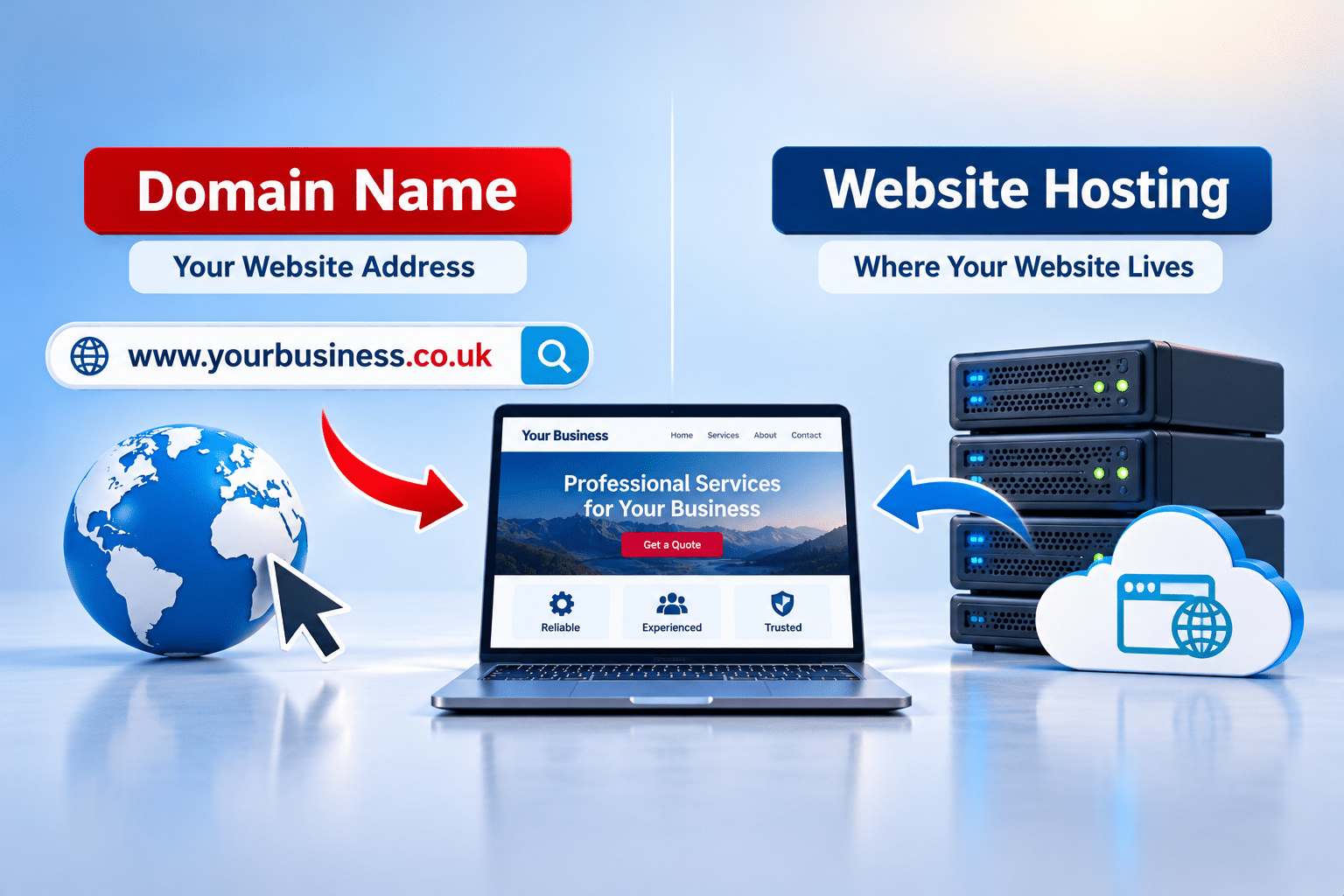
The difference between website hosting and a domain name is simple: your domain name is your website’s address, while website hosting is the service that stores and delivers your website’s content.
For example, yourbusiness.co.uk could be your domain name. Your hosting service stores the website files, images, database and other information needed to display your website when someone visits that address.
You usually pay to register and renew your domain name, and separately for hosting, although some providers combine both services into one package. You can also use different companies for each. Understanding how they connect helps you manage your website, business email and future changes of provider.
An Easy Way to Understand the Difference
Imagine you’re opening a shop.
First, you need an address so customers know where to find you. That’s similar to your domain name.
Next, you need premises where you can display your products, welcome customers and run the business. That’s similar to website hosting.
Your website itself is like the shop you’ve created inside those premises.
The address tells customers where to go, while the premises provide somewhere for your business to operate.
It’s not a perfect technical comparison, but it’s a useful way to remember the difference.
For a business website, your domain might be yourbusiness.co.uk, while your hosting service keeps the website available to visitors.
What Is a Domain Name?
A domain name is the address people type into their browser to find your website.
Examples include yourbusiness.co.uk and yourbusiness.com.
Instead of asking customers to remember a complicated numerical internet address, a domain name gives them something easier to recognise and use.
How do you get a domain name?
You register an available domain through a domain registrar or a company that offers domain registration services.
Registration gives you the right to use that domain for the agreed registration period, subject to the relevant registry’s rules and your registration terms.
It doesn’t mean you’ve purchased the name permanently. You normally need to renew it to keep using it.
What makes a good business domain name?
- It’s easy to spell and remember.
- It’s closely connected to your business name.
- It’s not unnecessarily long.
- It’s easy to say over the telephone.
- It avoids confusing spelling and unnecessary hyphens.
- It doesn’t infringe someone else’s trademark rights.
For many UK businesses, a .co.uk or .uk domain can be a natural choice. A .com domain may also be suitable, particularly if your business serves customers internationally.
Choosing a domain is a business decision, not a guarantee of better Google rankings.
What Is Website Hosting?
Website hosting is the service that makes your website’s content available online.
A hosting provider supplies server resources, software and connectivity so visitors can access your website.
When someone opens a page, the hosting system delivers the information their browser needs to display it.
Depending on how the website is built, this can involve website files, images, a database and software such as WordPress.
What does a hosting service usually provide?
- Space and resources for your website.
- Internet connectivity for visitors.
- Server software needed to run your website.
- Security features, depending on the package.
- Backups, where included.
- Technical support, according to the provider’s terms.
- Tools for managing your hosting account.
Not all hosting packages include the same features. Some providers offer basic server space, while managed hosting may include additional maintenance, monitoring and support.
That’s why comparing hosting services on price alone can be misleading.
How Do Domain Names and Website Hosting Work Together?
When someone types your domain name into a browser, several things happen behind the scenes.
First, the browser needs to find out which server or service should handle the request. The internet’s Domain Name System, usually called DNS, helps with this process.
The browser then connects to the appropriate service, which delivers the website content.
Here’s the simplified process
- A customer enters your domain name into their browser.
- DNS helps direct the request to the correct website service.
- The browser connects to the website’s hosting infrastructure.
- The hosting system provides the page content.
- The browser displays the website to the visitor.
Modern websites can involve additional services, such as content delivery networks and security systems, but the basic principle remains the same.
Your domain tells the browser where to go. Your hosting makes the website available.
Domain Name Versus Website Hosting: Key Differences
| Feature | Domain Name | Website Hosting |
|---|---|---|
| Main purpose | Provides your website’s address. | Makes your website content available online. |
| Example | yourbusiness.co.uk | A managed WordPress hosting service. |
| What you pay for | The right to use the domain during its registration period. | Server resources and the services included in your plan. |
| Renewal | Usually renewed periodically. | Usually paid monthly or annually. |
| Can you change provider? | Generally yes, subject to applicable transfer rules. | Generally yes, with a suitable migration process. |
| Does it contain your website? | No. | Stores or delivers the website’s content and supporting resources. |
| Does it automatically include email? | No. | Only if the package includes email services. |
Although the two services are connected, they’re not interchangeable.
Do You Need Both a Domain Name and Hosting for a Business Website?
For a conventional business website using your own web address, you normally need a domain name and some form of hosting or website publishing service.
However, you don’t always need to buy them separately.
Some website-building platforms include hosting as part of their subscription. Others offer a free subdomain, such as a website address ending with the platform’s name.
That can be useful for testing ideas, but many established businesses prefer their own domain name.
Why use your own domain?
A domain linked to your business name can be easier to remember and more suitable for printed materials, advertising and business email.
It can also make it easier to keep a consistent public address if you change website providers later, provided you retain control of the domain.
You may be able to register a domain without launching a website immediately. This can be useful when securing a name for a future business.
How Much Do Domain Names and Website Hosting Cost?
Domain registration and website hosting are normally separate costs, even when they’re included in one package.
Domain name costs
Many standard domain names cost roughly £10 to £25 per year, but this is only an illustrative range. The actual price depends on the extension, registrar, promotional offers, taxes and whether the name is considered premium.
Some domains cost considerably more.
Always check the renewal price, not just the first-year offer.
Website hosting costs
Basic shared hosting can sometimes cost only a few pounds per month. Managed hosting, higher-performance services and specialist packages can cost more.
The price may depend on:
- Server resources and performance.
- Website traffic and storage requirements.
- Backups and security features.
- Technical support.
- Managed updates and maintenance.
- Email services.
- The number of websites hosted.
For a small business, the cheapest hosting isn’t automatically the best value. A website that frequently goes offline or receives poor support can create problems that cost more than the savings.
Compare the total annual cost and what the package actually includes.
Should You Buy Your Domain Name and Hosting From the Same Company?
You can register your domain and purchase hosting from the same company, or use two separate providers.
Neither arrangement is automatically better.
Using the same company
This can make billing and initial setup simpler. The provider may also configure the connection between your domain and hosting.
However, you should still understand who controls the domain and what happens if you decide to leave.
Using separate companies
Keeping your domain registration separate from hosting can give you more flexibility when changing hosting providers.
It may also reduce your dependence on one supplier.
The trade-off is that you may need to manage settings and support requests across two companies.
For most small businesses, the important issue isn’t whether you use one provider or two. It’s whether you have clear ownership, reliable services and access to the settings you need.
Who Owns Your Domain Name and Website?
This is one of the most important questions a small business owner should ask.
When a designer or agency sets up your website, they may register the domain and arrange hosting on your behalf.
That can be convenient, but you need to know whose details appear on the domain registration and who controls the relevant accounts.
Questions worth asking
- Is the domain registered in my business’s name or under my control?
- Who has access to the domain registrar account?
- Can I renew or transfer the domain if I change supplier?
- Who controls the website hosting account?
- Can I obtain a backup of my website?
- What happens if I stop using the current provider?
Domain registration rights, website intellectual property and hosting account access are different matters.
For example, paying a designer to build a website doesn’t automatically settle every question about copyright, licences or access. These should be clear in your agreement.
At A to Z Website Solutions, clients receive ownership of their completed website after final payment, in line with the agreed terms, and can choose to host it elsewhere.
What Is DNS and Why Does It Matter?
DNS stands for Domain Name System.
It helps connect easy-to-remember domain names with the technical information needed to reach websites and other internet services.
Think of it as a directory that helps your browser find the right destination.
Common DNS settings
- A record: Points a hostname to an IPv4 address.
- AAAA record: Points a hostname to an IPv6 address.
- CNAME record: Makes one hostname an alias of another.
- MX record: Identifies mail servers for a domain.
- TXT record: Can hold information used for verification and email security.
You don’t need to become a DNS expert to run a business website. However, knowing that these settings exist can help when moving hosting or setting up professional email.
Incorrect changes can stop your website or email from working, so keep a record of existing settings before changing them.
Does Website Hosting Include Business Email?
Not necessarily.
A domain name can be used for professional email addresses such as hello@yourbusiness.co.uk.
However, registering the domain doesn’t automatically provide an email inbox.
You also need an email service, which may be included with your hosting or purchased separately.
Common email arrangements
Some website hosting companies include mailboxes. Others focus entirely on website hosting and expect customers to use a separate email provider.
Businesses may also use specialist email services such as Microsoft 365 or Google Workspace.
Your domain’s DNS records help direct email to the correct provider.
This is particularly important when moving your website. You can change website hosting without changing your email provider, but only if the relevant DNS settings are preserved and configured correctly.
Can You Move Your Website Without Changing Its Domain Name?
Yes. In most cases, you can move your website to another hosting provider and keep the same domain name.
For example, your business could move from one WordPress hosting company to another while customers continue using the same website address.
What does a typical hosting move involve?
- Arrange suitable hosting with the new provider.
- Back up the website and database where applicable.
- Move the website to the new hosting environment.
- Test the website before changing the live connection.
- Update the relevant DNS settings.
- Check website pages, forms, security and email.
- Keep the old hosting available until the move has been verified.
DNS changes may take time to become visible across different networks because previously cached information can remain in use.
For that reason, a carefully planned migration is preferable to cancelling the old hosting immediately.
Changing your hosting provider is also different from transferring your domain registration to a new registrar. You can do one without necessarily doing the other.
What Happens if Your Domain Name or Hosting Expires?
This is where understanding the difference becomes especially important.
If your domain name expires
Your website address may stop working correctly, and email using that domain may also be affected.
Depending on the domain extension and registrar, there may be a renewal grace period or recovery process. However, recovery isn’t guaranteed in every situation.
If you fail to renew and eventually lose the registration, someone else may be able to register the domain when it becomes available.
If your hosting expires
Your website may become unavailable because the hosting service has been suspended or cancelled.
Your domain registration might still be active, but visitors may not be able to view the website.
Depending on the provider’s terms, website data may eventually be deleted after cancellation.
How to reduce the risk
- Keep domain and hosting renewal dates recorded.
- Use a reliable contact email for renewal notices.
- Consider automatic renewal where appropriate.
- Check that your payment details remain current.
- Maintain independent website backups.
- Keep your registrar login and recovery details secure.
A missed domain renewal can cause serious disruption, particularly when the domain is also used for business email.
What Should Small Businesses Look for When Choosing Hosting and a Domain?
Choosing the right services isn’t simply about finding the lowest monthly price.
For domain registration
Look for clear renewal costs, straightforward account access, suitable security features and a practical transfer process.
Check the registrar’s terms and make sure your contact details remain accurate.
For website hosting
Consider reliability, support, backups, security, performance and whether the package suits the type of website you have.
A small brochure website may need fewer resources than a busy online shop.
If you use WordPress, check whether the provider supports your website’s software requirements and offers the level of maintenance you need.
Don’t forget the full cost
Ask whether the advertised price includes VAT, backups, email, SSL certificates, migration assistance and ongoing support.
Some features may be included, while others may cost extra.
Clear pricing makes it easier to compare the real value of different packages.
Common Domain and Hosting Mistakes Small Businesses Should Avoid
Letting someone else control your domain without clear arrangements
Always know who the registered holder is and how you can access or transfer your domain.
Choosing hosting based only on the introductory price
Check renewal charges and included services. An inexpensive first year doesn’t necessarily mean good long-term value.
Assuming email will keep working after changing DNS
Website and email services may use different DNS records. Preserve the correct settings during changes.
Cancelling old hosting before testing the replacement
Move and test your website first. Keep a backup and allow time to confirm everything works.
Forgetting renewal dates
A lapsed domain or cancelled hosting service can interrupt your website and possibly your business email.
Assuming backups are always included
Check what is backed up, how often and whether you can restore the website when needed.
Important: Protect Your Domain Name
Your domain name may be used on your website, business cards, invoices, advertising and email addresses. Losing control of it can disrupt several parts of your business.
Keep your registrar account secure, enable multi-factor authentication where available and make sure renewal notices reach someone responsible for managing the domain.
Expert Insight From Daren Ward

Having worked in website design and development since 2004, I believe every business owner should understand the difference between their domain name, website hosting and the actual website.
You don’t need to know how to configure servers or manage complicated DNS records. But you should know where your domain is registered, who controls it and what happens if you want to change providers.
One thing I’d encourage business owners to check is whether they can access their domain registration independently of their website designer.
I’ve always believed customers should have the freedom to choose where their website is hosted after their project is completed and paid for. They shouldn’t feel trapped simply because one supplier manages several parts of their online presence.
I’d also recommend keeping a simple record of your domain renewal date, hosting arrangements and email provider. These details can save a lot of confusion if something goes wrong or you decide to move your website.
My advice is to ask questions before agreeing to a website package. A good provider should be able to explain what you’re paying for, what you own and what support is included in plain English.
Action Checklist: Check Your Domain and Website Hosting
- Find out which company your domain is registered with.
- Confirm who is recorded as the domain’s registered holder.
- Make sure you can access the registrar account or arrange access when needed.
- Record your domain renewal date and cost.
- Find out which company hosts your website.
- Check your hosting renewal date and ongoing charges.
- Confirm what backups and security features are included.
- Identify which company provides your business email.
- Keep a secure record of important account details.
- Check whether you can move your website to another host.
- Review whether your hosting package suits your current website.
- Enable suitable account security and renewal reminders.
Frequently Asked Questions
1. What is the difference between website hosting and a domain name?
A domain name is the address people use to find your website. Hosting provides the server resources and services that make your website available online.
2. Can I buy a domain name without hosting?
Yes. You can register a domain before building a website. You’ll normally need a suitable hosting or publishing service when you’re ready to launch.
3. Can I have website hosting without a domain name?
Yes. Some hosting services provide temporary addresses or subdomains. However, most businesses prefer a domain name connected to their own brand.
4. Do I have to buy my domain and hosting from the same company?
No. You can use different providers for domain registration and website hosting. DNS settings connect the two services.
5. Does buying a domain name mean I own it forever?
No. Domain registration generally gives you the right to use the name for a registration period. You need to renew it according to the applicable rules.
6. Can I change hosting companies and keep my domain?
Yes. You can usually move your website to another host while keeping the same domain name. The migration and DNS settings need to be handled correctly.
7. Does website hosting include an email address?
Not always. Some hosting packages include email, while others require a separate email service. Registering a domain alone doesn’t create a mailbox.
8. What happens if I forget to renew my domain?
Your website and domain-based email may stop working. Recovery options vary, and you could eventually lose the registration if it isn’t renewed.
9. What happens if I stop paying for website hosting?
Your hosting provider may suspend or cancel the service, making your website unavailable. The domain may remain registered separately.
10. Is expensive website hosting always better?
No. The best choice depends on your website’s needs. Compare reliability, support, performance, security, backups and the total cost rather than price alone.
11. Can my website designer keep control of my domain?
A designer may manage a domain on your behalf, but the registration arrangements should be clear. Confirm who holds the registration rights and how you can obtain access or transfer the domain.
12. What is DNS in simple terms?
DNS is a system that helps internet services find the correct destination for a domain name. It plays an important role in connecting websites and directing email.
Summary: Your Domain Is the Address, Hosting Makes the Website Available
The difference between a domain name and website hosting is straightforward once you understand what each service does.
Your domain name is the address customers use to find your website. Hosting provides the resources needed to make the website available online.
They normally work together, but you don’t have to purchase them from the same company.
For small business owners, the most important things are choosing reliable services, understanding the costs and keeping control of your domain and website.
With those basics in place, you’ll be in a better position to manage your online presence and avoid unnecessary problems.
Your Next Step
If you’re unsure whether your existing website is performing as well as it should, A to Z Website Solutions can help you identify potential improvements.
Request a Free Website Audit and receive separate desktop and mobile reports, with no obligation.
You can also explore our website design and digital services if you’re planning a new business website.
Key Takeaways
- A domain name is your website’s address.
- Website hosting makes your website content available online.
- You normally need both for a business website with your own domain.
- Domain registration and hosting can be purchased from separate companies.
- Domain names require renewal to maintain registration rights.
- Business email may be a separate service.
- DNS connects your domain with website and email services.
- You can usually change hosting without changing your domain.
- Always check renewal prices, backups, support and account access.
- Keep control of your domain registration and understand your website ownership arrangements.
Found This Helpful? Share It
If this article helped you, please share it with another small business owner.