
Landing Page vs Website: What’s the Difference?
If you’re planning to promote your business online, you may be wondering whether you need a landing page, a full website or both. They can look similar on the screen, but they usually have very different jobs.
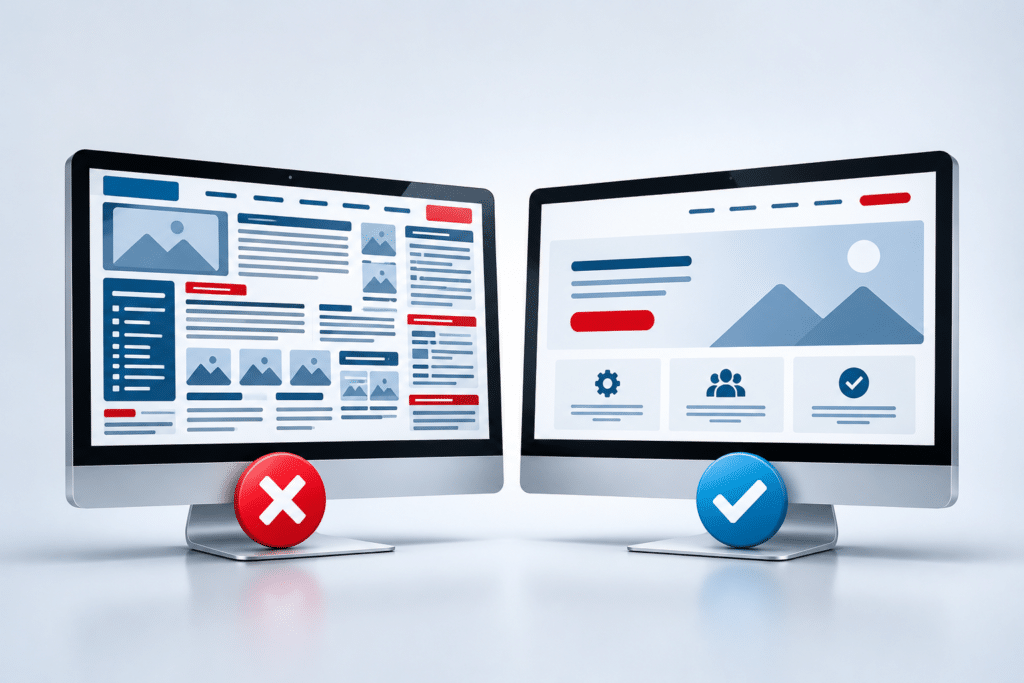
The landing page vs website decision becomes much easier once you think about what you want visitors to do. A website normally gives people a wider picture of your business and lets them explore different information. A landing page is usually much more focused and guides the visitor towards one particular action.
Quick Answer
A website is normally made up of several pages covering your business, services, contact information and other useful content. Visitors can move around the site and decide what they want to explore. A landing page is usually a single focused page created around one campaign, offer or action, such as requesting a quote, booking an appointment, downloading a guide or buying a particular product. Many businesses benefit from having a full website for their main online presence and using separate landing pages for specific marketing campaigns.
What Is a Landing Page?
A landing page is a web page designed around a specific purpose. Instead of giving visitors lots of different places to go, it normally concentrates their attention on one offer, campaign or next step.
For example, imagine a plumbing company is running an advert promoting boiler servicing. Rather than sending people to the general homepage, the advert could send them to a dedicated page explaining the boiler servicing offer, what is included, why customers might choose the company and how to request an appointment.
The visitor has arrived for a particular reason, so the page can continue the same conversation. There is less need for them to search through a general website to find the information that attracted them in the first place.
Google Ads describes a landing page as the webpage someone reaches after clicking an advert. In marketing more generally, the term is also commonly used for focused pages connected to campaigns from sources such as email and social media.
What is the main purpose of a landing page?
The main purpose is usually to encourage one clear action. That action depends on the campaign and could include requesting a quote, making a booking, completing an enquiry form, signing up, downloading something or purchasing a particular product.
This does not mean every landing page should contain nothing except a form and a button. Visitors still need enough useful information to understand the offer, decide whether it is relevant and feel comfortable taking the next step.
What Is a Website?
A business website usually has a broader job. It represents the business online and gives visitors different routes depending on what they need.
A typical small business website might contain a homepage, individual service pages, an about page, contact information, FAQs, blog articles and other useful pages. A restaurant might also include menus and booking information, while an accountant could have separate pages explaining bookkeeping, payroll and tax services.
Someone visiting the website may not yet know exactly what they want. They might want to compare services, check where the business operates, learn about its experience, read helpful information or find contact details. The website allows that exploration.
This makes a website particularly useful as the main online home of a business. It can support several services, different types of customer and a much wider range of searches and questions than one tightly focused landing page.
Landing Page vs Website: The Main Differences
The simplest way to understand the difference is to compare their jobs. A landing page normally narrows the visitor’s choices, while a website gives the visitor more opportunities to explore.
| Area | Landing Page | Website |
|---|---|---|
| Primary purpose | Focus on one campaign, offer or action | Represent the wider business online |
| Typical size | Usually one focused page | Usually multiple connected pages |
| Navigation | Often limited to reduce distractions | Usually includes full site navigation |
| Visitor journey | More controlled and focused | Allows wider exploration |
| Content | Centred on one specific subject or offer | Covers the business, services and related information |
| Common traffic sources | Ads, email campaigns, social promotions and specific campaigns | Search engines, direct visits, referrals, social media and other sources |
| Calls to action | Usually built around one main action | May contain several different actions across the site |
| Best suited to | A focused marketing goal | A broader long-term online presence |
Neither option is automatically better. They solve different problems. The right choice depends on what the visitor needs and what you want that visitor to do.
When Should You Use a Landing Page?
A landing page is particularly useful when you already know why someone is arriving and you want the page to continue that specific journey.
Suppose a beauty salon runs a social media promotion for a particular treatment. Sending people to the general homepage could mean they then need to find the treatment, check the details and work out how to book. A dedicated landing page could keep all the relevant information and the booking action together.
Other situations where a landing page may make sense include:
- Running a Google Ads campaign for one service
- Promoting a particular offer
- Collecting enquiries for a specific service
- Encouraging registrations for an event
- Building an email subscriber list
- Offering a downloadable guide or resource
- Promoting a new product
- Sending people from a targeted email campaign
The key question is whether the visitor has arrived with a clear reason. If they have, a focused page can make the next step easier to understand.
Why not just send everyone to your homepage?
Your homepage has to serve many different visitors. It might introduce the company, show several services, explain why people should trust you and provide routes into the rest of the website. That flexibility is useful for general visitors but may be less suitable for a very specific campaign.
Imagine an electrician advertising emergency call-outs. Someone clicking that advert probably wants immediate information about emergency electrical help, not an introduction to rewiring, landlord services and every other service the electrician provides.
A dedicated landing page lets the message before the click and the message after the click stay closely connected.
When Should You Use a Website?
A full website makes more sense when visitors need to understand your wider business rather than one campaign or offer.
For most established small businesses, a website can act as the main place where customers learn what the business does. It can answer different questions for people at different stages of making a decision.
For example, someone looking for an accountant may want to understand the services offered, where the accountant is based, who they work with and how to make contact. Another visitor might arrive through a useful article and later explore the accountant’s services.
A full website gives you room to organise that information properly rather than trying to squeeze every possible customer question onto one page.
A website can support several customer journeys
Not every visitor arrives ready to enquire. Some are researching. Some are comparing businesses. Some already know your company and simply need your telephone number. Others may be looking for one particular service.
A well-structured website can serve these different needs through separate pages and clear navigation. That is one reason a full website is normally better suited to representing the business as a whole.
Do You Need Both a Landing Page and a Website?
Many businesses can benefit from using both because the two do not have to compete with each other. Your main website can provide the wider business information, while landing pages can support particular marketing campaigns.
Consider a landscaping company with a website covering garden design, patios, fencing and regular garden maintenance. During spring, the company might run an advertising campaign specifically for patio installations. A dedicated patio landing page could support that campaign while the main website continues to serve people looking for all the company’s other services.
This approach also means you do not have to keep changing your homepage every time you launch a new promotion. The homepage can continue doing its main job while individual campaigns have pages designed around their own messages and goals.
A landing page can still be part of your main website
A landing page does not necessarily need to sit on a completely separate website. It can be a page within your existing business website, using the same domain and branding while having a more focused layout.
This can be useful because your website and landing pages can work as parts of the same online presence. The important distinction is the purpose of the page, not simply where it is hosted.
Can You Have a Landing Page Without a Website?
Yes, technically you can have a standalone landing page without building a traditional multi-page website first. For a short-term campaign, new idea or very simple offer, that may sometimes be enough.
However, you should think about what happens when a potential customer wants to know more about the business. A landing page designed around one offer may not answer broader questions about your other services, background, useful information or different ways to contact you.
Google itself distinguishes between an advertising destination and a wider business website. Its Google Ads guidance also notes that some businesses can use an optimised Google Business Profile as an advertising landing destination, while stating that this is not a replacement for a business website.
For a new business testing one idea, starting with a landing page can therefore be a practical option. For a business that needs a broader long-term online presence, a full website will usually have a different and wider role.
The Mistake of Asking One Page to Do Everything
One of the most useful ways to make the landing page vs website decision is to stop thinking about the number of pages and start thinking about the number of jobs you are asking the page to perform.
If one page has to introduce your business, explain six services, tell your story, answer common questions, promote a special offer, collect newsletter subscribers and persuade visitors to request a quote, the main action can become harder to see.
The opposite problem can happen too. A business may create a very narrow landing page and then expect it to act as its complete online presence for every type of customer.
Start with the visitor’s reason for arriving. If there is one clear campaign and one main action, a landing page may be the better fit. If visitors need to explore the wider business, a website usually gives you more room to help them.
Expert Insight From Daren Ward

Daren Ward – Founder, A to Z Website Solutions
From my experience working with business websites since 2004, one mistake is treating a landing page as simply a shorter website. I would look at it differently. The starting point should be the job you need the page to do.
If you’re paying to send people to a page because they are interested in one specific service or offer, I would normally keep that journey focused. If somebody is researching your whole business and comparing several services, they need more freedom to explore. Designing around that difference can make the experience much clearer for the visitor.
Action Checklist: Which One Does Your Business Need?
Before deciding between a landing page and a website, work through these questions:
- Define the goal: Decide whether you are promoting one specific action or your wider business.
- Consider the traffic source: Think about whether visitors are coming from a focused advert or general sources such as search and referrals.
- List what visitors need to know: A simple offer may fit one page, while several services may need a full website structure.
- Choose the main action: Decide whether you want a quote request, booking, purchase, registration, phone call or something else.
- Check for unnecessary distractions: A campaign page should not make people hunt for the action they came to take.
- Think beyond the campaign: Ask where customers will go when they want to learn more about your overall business.
- Consider using both: Your website can support the business generally while landing pages support individual campaigns.
Frequently Asked Questions
Is a landing page the same as a homepage?
No. A homepage normally introduces the wider business and helps visitors move into different areas of the website. A landing page is usually created for a more specific campaign, audience or action. Although a homepage can technically be the page somebody lands on, its business purpose is normally broader.
Does a landing page need navigation?
Not always. Some landing pages use limited navigation because the aim is to keep visitors focused on one particular journey. However, removing navigation is not a rule that applies to every landing page. The layout should make sense for the visitor, the campaign and the information they may reasonably need.
How many pages does a website need?
There is no fixed number. A small local business might only need a handful of well-planned pages, while a company with many services may need considerably more. The better question is whether each important customer need has enough clear information rather than aiming for an arbitrary page count.
Can a landing page rank on Google?
A landing page can potentially appear in organic search if search engines can crawl and index it and the page is relevant and useful for a search. However, creating a landing page does not guarantee rankings. Some landing pages are created mainly for paid advertising or private campaigns rather than organic search.
Can I use a landing page for Google Ads?
Yes. Landing pages are commonly used with Google Ads. Google defines the landing page as the webpage people reach after clicking an advert and says the usefulness and relevance of the page, ease of navigation and whether it meets the visitor’s expectations can contribute to landing page experience.
Should every service have its own landing page?
Not necessarily. Your main website may already have useful service pages explaining each service properly. A separate landing page becomes more useful when you have a specific campaign, audience, offer or action that would benefit from a more focused journey.
Can I send social media traffic to a landing page?
Yes. A landing page can be used for traffic from social media posts and campaigns when you want visitors to take a particular next step. For example, a cleaning company promoting an end-of-tenancy cleaning offer could direct interested visitors to a page created specifically around that service.
Is a one-page website the same as a landing page?
No. They can look similar because both may consist of one page, but their purpose can be different. A one-page website may try to represent the whole business, with sections for services, about information and contact details. A landing page normally has a narrower campaign or conversion goal.
Do I need a landing page if I already have a website?
Not automatically. If an existing website page already matches the campaign closely and gives visitors a clear next step, creating another page may add little value. A separate landing page is worth considering when the existing website experience is too broad for the particular campaign.
Which is better for a new small business, a landing page or website?
It depends on what the business needs first. If you are testing one simple offer, a landing page may provide a focused starting point. If customers need information about several services and the wider business, a website is likely to be more useful. Some businesses start small and add further pages as their needs grow.
Summary
A landing page and a website are both collections of web content, but they are normally designed to solve different problems. A website provides a broader online home where visitors can explore your business, services and information. A landing page narrows the journey around a particular campaign, offer or action.
For many small businesses, this is not an either-or decision. A website can handle the wider job of representing the business while landing pages provide focused destinations for selected adverts, emails, social campaigns and promotions.
The most useful question is therefore not simply, “Do I need a landing page or a website?” Ask what the visitor is trying to achieve, what information they need and what you want them to do next.
Choosing Your Next Step
If you have one focused campaign or offer and want a page built around a clear action, you can explore our landing page design service. If you need a broader online presence covering your business and services, our business website design service explains the alternative.
A to Z Website Solutions has provided website design and online marketing services since 2004. The important part is choosing the type of page that fits what your business and your customers actually need.
Key Takeaways
- A landing page normally focuses on one campaign, offer or main action.
- A website provides a broader online presence and usually contains several connected pages.
- Landing pages can be useful for advertising, email, social campaigns, lead generation and specific promotions.
- A full website gives customers more freedom to explore your business and services.
- A landing page can sit within your existing website and use the same domain.
- You do not always have to choose one or the other. Many businesses can use both for different purposes.
- Choose based on the visitor’s reason for arriving and the action you want them to take.