What Is Local Website Design? A Guide for Small Businesses
If your business mainly serves customers in a particular town, city or surrounding area, your website has a different job from a website trying to reach customers across the whole country.
A plumber in Dartford doesn’t necessarily need enquiries from Manchester. A beauty salon in Bexley probably isn’t interested in attracting someone searching for a salon in Birmingham. A local accountant may work with clients across several nearby towns but have little reason to compete nationally.
This is where local website design comes in. Instead of building a website that simply explains what the business does, the website is planned around the services offered, the customers the business wants to attract and the geographical area it actually serves.
Quick Answer: What Is Local Website Design?
Local website design is the process of creating a business website specifically to attract and convert customers from a defined geographical area. It combines good website design with clear service information, location signals, local SEO foundations, trust information and simple ways for potential customers to make contact.
For example, an electrician serving Dartford, Gravesend and nearby areas may need a website that clearly explains the electrical services offered, where the business works, why local customers should trust it and how to request a quote. The aim isn’t simply to have a good-looking website. It is to help the right local customers find the business, understand what it offers and take the next step.
How Does Local Website Design Work?
Local website design starts with a simple question: who does the business actually want to attract? The answer affects almost everything from the wording on the homepage to the services that receive the most attention.
Imagine a landscaping company that works within roughly 20 miles of its base. Its ideal visitor might search for a landscaper, garden designer, patio installer or fencing company in a nearby town. When that person reaches the website, they will usually want answers to some basic questions quickly.
Does the company provide the service I need? Does it work in my area? Can I see examples of its work? Does the business look trustworthy? How do I ask for a quote?
A locally focused website is designed to answer those questions clearly. The location matters, but local website design is about much more than repeatedly adding a town name to a page.
How Is a Local Business Website Different?
There isn’t a completely separate type of technology called a “local website”. A local website can still be built using WordPress or another suitable website platform.
The main difference is the strategy behind it. A website selling products throughout the UK may need to appeal to a very broad audience. A local service business needs to make it obvious what it does, where it operates and why someone nearby should consider contacting it.
| General Business Website | Locally Focused Business Website |
|---|---|
| May target customers across the UK or further afield | Focuses on customers within relevant towns, cities or service areas |
| Location may play a small role | Makes the genuine service area clear |
| May use broad service messaging | Connects services with the needs of local customers |
| May have broad calls to action | Often focuses on calls, quote requests, enquiries, bookings or visits |
| Trust may be built around national credentials | Can use relevant local reviews, project examples and business information |
Neither approach is automatically better. It depends on the business. If you operate nationally, concentrating your whole website on one town would make little sense. If most of your customers come from within ten miles of your business, ignoring location would also be a missed opportunity.
What Does a Good Local Business Website Need?
A useful local business website needs to do several jobs at once. It needs to explain the business clearly, build confidence, work properly on mobile devices and make contacting the business straightforward.
Clear Explanation of What You Do
Visitors shouldn’t have to study your website to work out what your business offers. If you’re a plumber offering boiler repairs, bathroom plumbing and emergency call-outs, those services should be easy to find and understand.
This also helps search engines understand the subject of your pages. Rather than trying to put every service into one large block of text, important services may justify their own useful pages where there is enough information to help the customer.
A Clear Service Area
Tell customers where you genuinely operate. Depending on the business, that could be one town, several neighbouring areas, a county or a defined radius.
This prevents visitors from having to wonder whether you cover their location. It also gives search engines clearer information about the geographical relationship between your business, services and customers.
Easy Ways to Contact You
Local customers are often looking for a practical next step. Someone with a leaking pipe may want to call. A homeowner planning a new garden may prefer to request a quote. Someone looking for a beauty treatment may want to book an appointment.
Your website should make the appropriate next step obvious. Telephone numbers, enquiry forms, booking options and quote requests should be easy to find, particularly on mobile devices.
Trust Information
A visitor may be comparing several local businesses. Your website needs to give them enough information to decide whether they feel comfortable contacting you.
Depending on the type of business, useful trust information can include genuine customer reviews, photographs of completed work, information about your experience, qualifications where relevant, guarantees you genuinely offer, clear contact details and an informative About page.
Good Mobile Design
Local searches often happen when people need something quickly, so a website that is awkward to use on a phone can create unnecessary barriers. Text should be readable, navigation should be straightforward and important contact options should be easy to use.
Mobile design isn’t simply about shrinking a desktop website to fit a smaller screen. The whole experience needs to remain practical when someone is using a phone.
What Does Local Website Design Have to Do With Local SEO?
Local website design and local SEO are closely connected, although they aren’t exactly the same thing. Website design deals with the structure, presentation and user experience of the site, while local SEO covers a wider range of work intended to help a business become more visible for relevant local searches.
Google says its local results are mainly based on relevance, distance and prominence. It also says that information from a business’s official website can be among the publicly available sources used for business information.
That means your website is one part of the wider local search picture. It can clearly describe your services, location and business, but having a locally optimised website doesn’t guarantee a particular Google position.
Useful website foundations can include clear page titles, logical headings, useful service content, accurate business information, internal links, good mobile usability and appropriate structured data.
Structured data is information added to a website in a standardised format to help search engines understand what the page represents. Google supports LocalBusiness structured data and recommends using the most specific business type that accurately describes the organisation where appropriate.
How Does Your Google Business Profile Fit In?
Your website shouldn’t be considered in isolation from your Google Business Profile. For eligible local businesses, the two can support the same overall goal of helping nearby customers understand and find the business.
Google describes a Business Profile as a way for eligible businesses to manage how they appear on Google Search and Maps. A profile can contain details such as the business’s website, telephone number, location or service area, opening hours, photographs and customer reviews.
Consistency matters. If your website says you provide one set of services while your Business Profile gives a confusing or outdated picture, you’re making it harder for customers to understand the business.
Your website gives you much more space to explain what you do. Your Business Profile provides another route for customers to discover the business through Google Search and Maps. They should therefore complement each other rather than being treated as unrelated marketing tools.
Does Your Website Need Location Pages?
Sometimes, but not automatically. If you genuinely provide services across several important locations, useful location pages may help visitors understand what you offer in those areas.
The key word is useful. Creating dozens of nearly identical pages and changing only the town name provides very little value to a potential customer.
If an electrician genuinely serves Dartford, Gravesend and Bexley, for example, location content could explain the relevant services available in those areas, practical service information and genuine local context where appropriate. There should be a reason for the page to exist beyond targeting another place name.
For a business operating across a smaller area, one well-written service area section may be enough. The right approach depends on the size of the area, the services offered and how customers search for them.
Turning Local Visitors Into Enquiries
Being found is only half the job. Once somebody arrives on the website, the site still needs to persuade that person that contacting the business is worth their time.
Think about a homeowner searching for an electrician after discovering a problem with their fuse box. They may open several websites within a few minutes. A website that immediately explains the service, confirms the area covered, provides signs that the business is genuine and offers a clear way to make contact has removed several obstacles.
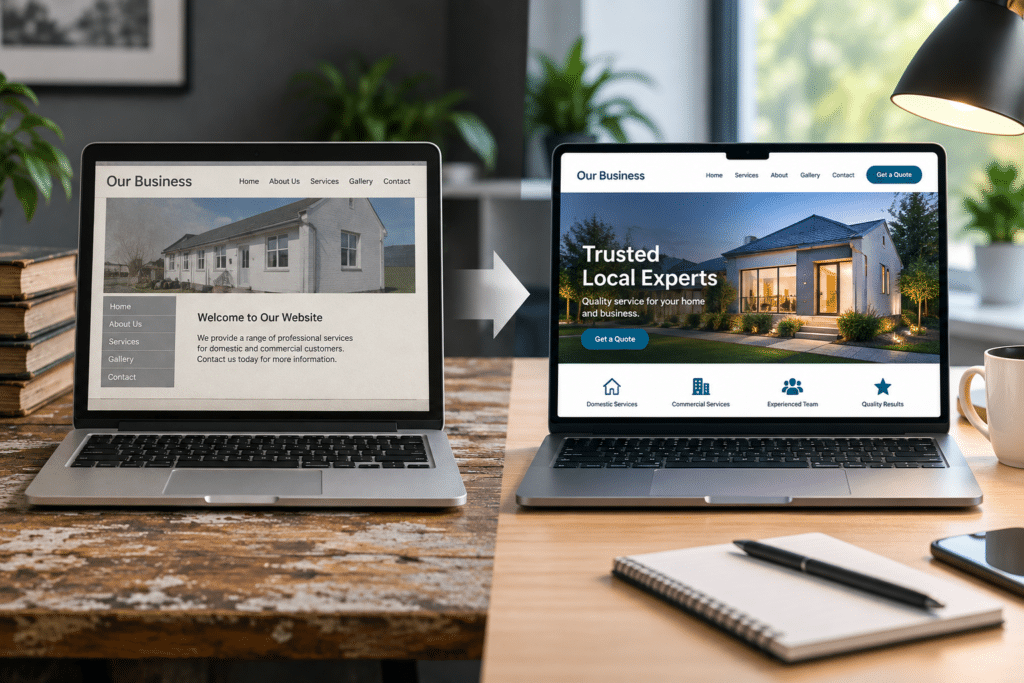
Compare that with a website containing a vague headline, no obvious location, very little service information and a telephone number hidden at the bottom. Even if that business provides excellent work, the website isn’t making it easy for a new customer to discover that.
Good local website design therefore considers what happens after someone arrives. Visibility can bring people to a website, but clear information, trust and usability help turn some of those visitors into genuine enquiries.
Common Local Website Design Mistakes
Trying to Target Everywhere
A business may be tempted to list every town within a huge radius in the hope of appearing in more searches. That can make the website less focused and may attract enquiries from areas the business doesn’t really want to serve.
Concentrate on the places you genuinely work in and want more customers from.
Repeating Place Names Unnaturally
Local optimisation isn’t about squeezing the same town name into every sentence. Content still needs to sound natural and help the person reading it.
Location should appear where it provides useful context, not simply because someone thinks repeating it will improve rankings.
Focusing on the Business Instead of the Customer
Some websites spend most of their space talking about the company while giving surprisingly little attention to what customers actually need.
A cleaning company’s potential customer may want to know which cleaning services are available, whether their area is covered, how the process works and how to request a quote. Company history can help build trust, but it shouldn’t replace the information people came looking for.
Hiding Contact Information
Don’t make an interested customer search for a way to contact you. If telephone enquiries are important, make the number easy to find. If quotes are the main goal, provide a clear quote request route.
The best call to action depends on how your customers normally buy or enquire.
Designing for Looks Alone
Attractive design matters because it affects the impression your business creates. But a beautiful website that doesn’t clearly explain your services or generate useful enquiries isn’t doing its full job.
Design should support the customer’s journey rather than getting in the way of it.
Expert Insight From Daren Ward
Daren Ward — Founder, A to Z Website Solutions
I’ve worked in website design and online marketing since 2004, and one thing I’ve seen repeatedly is businesses concentrating heavily on how a website looks while overlooking the simple questions a potential customer wants answered.
For a local business, I would normally start with the customer rather than the design. What service are they looking for? Which area are they in? What information would make them comfortable contacting the business? What might make them leave and look at a competitor instead?
Once those questions are understood, the design has a clearer purpose. You can build the navigation, page structure, service information, trust elements and calls to action around what a genuine local customer needs rather than simply producing something that looks impressive.
In my experience, that’s an important difference between simply having a website and having a website that has been planned around generating local business.
Local Website Action Checklist
If you already have a local business website, check the following:
- Can a new visitor understand what your business does within a few seconds?
- Does your website clearly explain the towns or areas you genuinely serve?
- Do your main services have enough useful information?
- Is your telephone number or main enquiry method easy to find?
- Can visitors use the website comfortably on a mobile phone?
- Does the website contain genuine trust information such as reviews, experience or examples of work where appropriate?
- Are your business details accurate and consistent?
- Does your Google Business Profile link to the correct website?
- Does your website clearly explain why a customer should consider your business?
- Have you checked whether old pages contain outdated services, locations or contact information?
Frequently Asked Questions About Local Website Design
What does local website design mean?
Local website design means creating a website around the needs of a business serving customers in a particular geographical area. The website normally makes the services, service area, contact options and reasons to trust the business clear.
Who needs a local business website?
Businesses that depend heavily on customers from a particular area are the most obvious candidates. Examples include plumbers, electricians, builders, cleaners, accountants, beauty salons, restaurants, landscapers and many other local service businesses.
Is local website design the same as local SEO?
No. They overlap, but they aren’t identical. Local website design covers the structure, content, presentation and user experience of the website, while local SEO includes wider work intended to improve visibility for relevant local searches.
Can a website help my business appear in local Google searches?
A well-structured website can help Google understand information about your business and services, but it cannot guarantee local rankings. Google says local results are mainly influenced by relevance, distance and prominence, and many factors can affect visibility.
Do I still need a website if I have a Google Business Profile?
A website and Google Business Profile perform different jobs. A Business Profile can help customers discover important business information through Google Search and Maps, while your website gives you far more space to explain services, answer questions, show your work and guide visitors towards an enquiry.
Should every town I serve have its own page?
Not necessarily. Separate location pages make the most sense when they provide genuinely useful information for customers in those areas. Creating large numbers of almost identical pages with only the town name changed isn’t a useful strategy for visitors.
Should I put my town name in my website headings?
It can make sense where the location is relevant to the page and helps describe the business clearly. It shouldn’t be forced into headings or repeated unnaturally simply for SEO.
What pages should a local business website have?
This depends on the business, but many local websites benefit from a clear homepage, service pages, About page, contact page and useful information about the areas served. Galleries, reviews, FAQs, booking pages or quote request pages may also be appropriate.
Can one local website target several towns?
Yes. A business serving several nearby towns can explain its genuine service area through its website. The structure should reflect how the business actually operates rather than creating artificial locations simply to target more search terms.
How important are customer reviews on a local website?
Genuine reviews can help potential customers judge whether they feel comfortable contacting a business. They can be particularly useful when a visitor is comparing several local providers offering similar services.
Does local website design work for service-area businesses without a shop?
Yes. Many local businesses travel to their customers rather than operating from premises that customers visit. Builders, plumbers, electricians, cleaners and landscapers are common examples. Their websites can clearly explain the areas they genuinely serve without pretending they have physical offices in every town.
Summary
Local website design is about building a website around the customers a local business actually wants to attract. Location is part of the strategy, but simply mentioning a town repeatedly doesn’t make a website locally effective.
A useful local website clearly explains what the business does, where it operates, why customers should trust it and how to get in touch. It should also work well on mobile devices and provide search engines with clear, accurate information about the business.
For a plumber, electrician, accountant, cleaner, beauty salon, landscaper or other local business, the goal is straightforward: help the right people discover the business, quickly understand whether it can help them and make taking the next step as easy as possible.
Need Help With a Local Business Website?
If your business depends on local customers, your website should be built around more than appearance. It needs to explain your services clearly, show where you work, build trust and make it easy for potential customers to contact you.
A to Z Website Solutions has been providing website design and online marketing services since 2004. We can help you create or improve a website that is designed around your business, your services and the local customers you want to reach.
If your existing website isn’t generating the local enquiries you expected, it may also be worth reviewing the content, structure, mobile experience, calls to action and local search foundations before assuming that you need to start again.
Key Takeaways
- Local website design focuses a website on customers within a genuine geographical service area.
- It is particularly useful for businesses such as plumbers, electricians, cleaners, accountants, salons, builders and landscapers.
- A local website should make services, areas covered, trust information and contact options easy to understand.
- Local website design and local SEO work together but aren’t the same thing.
- Your website and Google Business Profile can complement each other when their information is clear and accurate.
- Location pages should provide genuine value rather than simply repeating the same content with different town names.
- Good local website design considers what happens after somebody arrives, not just how the visitor found the site.
- No website design or SEO technique can guarantee a particular position in Google’s local results.